Today, Wuxi Rihuan Sensor Technology Co., Ltd. will introduce to you U-shaped insert + magnetic coding: Why this safety door lock is "unbreakable and unfoiled"?
In industrial safety protection, the safety door lock is the last physical barrier to prevent people from entering dangerous areas. However, many ordinary door locks have a fatal flaw: with a screwdriver or a common magnet, it can make the "think that the door is closed".
The judgment logic of ordinary magnetic safety switches (such as reed switch type) is extremely simple - "there is a magnetic field, it closes". This means that as long as the operator brings a refrigerator sticker or a strong magnet close to the sensor, the system will receive the "door is closed" signal, and the equipment will continue to operate as usual, while the protective door is actually wide open. This "cheating" behavior is explicitly listed as one of the most common evasion methods in EN ISO 14119 standards.
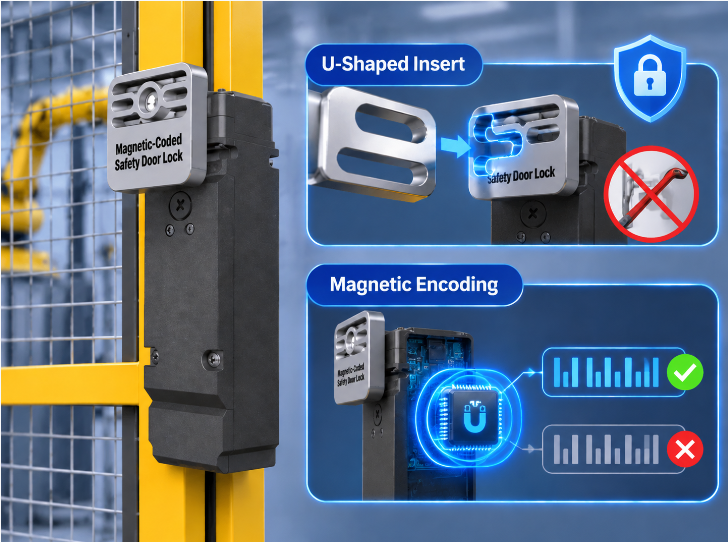
The magnetic coding safety door lock (with U-shaped insert design) can prevent such cheating by relying on a dual defense line of physical anti-pick and electronic coding.
The first line of defense: The mechanical anti-pick structure of the U-shaped insert
The U-shaped insert is not a random piece of iron. Its geometric shape precisely fits the lock tongue mechanism inside the lock body, and after insertion, it forms a mechanical lock. To forcibly pry open the lock tongue with a screwdriver requires overcoming the mechanical pre-tightening force of the spring and the meshing structure between the insert and the lock tongue - this is not something that can be opened by "just pushing once".
More importantly, even if someone uses violent means to damage the U-shaped insert or the external structure of the lock body, the magnetic coding sensor inside the lock body will not "mistakenly" judge that the door is closed. The mechanical lock is independent of the electronic detection: the insert must be fully inserted in place for the sensor to read the correct magnetic coding signal. Physically unbreakable, electronically unfoiled, both lines of defense are held at the same time, which is the effective anti-tampering.
The second line of defense: The magnetic coding sensor only recognizes "its own people"
The core of the magnetic coding safety door lock lies in the sensor only recognizing the unique arrangement of magnetic poles of the matching actuator (insert).
The judgment criterion of the ordinary magnetic switch is "whether there is a magnetic field". While the magnetic coding sensor's criterion is: "the detected magnetic field pattern, whether it is completely consistent with the reference pattern stored internally". Each magnetic coding actuator has a specific arrangement of permanent magnet arrays (different magnetic pole directions, different intensities combinations), and the sensor internally stores the matching "reference fingerprint".
When someone uses a common magnet close to the sensor, although the magnetic field strength may be sufficient, the arrangement pattern of the magnetic poles does not match. The sensor completes the "read, compare, determine" three steps within milliseconds: read the magnetic pattern of the actuator, compare it with the internal reference, only if it is completely consistent, will it allow the output of a safe signal. The magnetic field of a common magnet is chaotic and without coding, and it cannot pass this comparison.
This mechanism is classified as "high coding level" anti-tampering measures in EN ISO 14119. The standard clearly states that for protective doors that need to be frequently opened and will cause serious harm if bypassed, a high-coding-level interlock device must be used, because "the temptation for the operator to bypass the sensor for convenience is real".
Why is "both" indispensable?
Without magnetic coding, but with magnetic coding: Others can use a magnet sticker placed at the sensor position to simulate the "door is closed" signal, and the equipment continues to operate.
Without a sturdy U-shaped insert, but with magnetic coding: The sensor may not be fooled, but the lock body itself can be forcibly pried open, physically allowing someone to enter.
The U-shaped insert tube is "unbreakable", the magnetic coding tube is "unfoiled". The combination of both makes the safety door lock truly stand firm in the "someone wants to take a shortcut" on-site environment.
Rihuan Sensing offers security door lock products with encoding recognition function. The actuator adopts a unique encoding design, and the sensor only recognizes the paired actuator, effectively preventing bypass by ordinary magnets or foreign objects. The product contacts are forcibly disconnected, meeting the requirements of EN ISO 14119 for tamper-proof interlock devices. Welcome to follow Rihuan Sensing to obtain professional safety protection selection support.
