Today, Wuxi Rihuan Sensing Technology Co., Ltd. will introduce to you how to detect extremely fine wires, grids, and holes, and whether there is a total missed detection. Try the area-type (or surface-type) optical fiber!
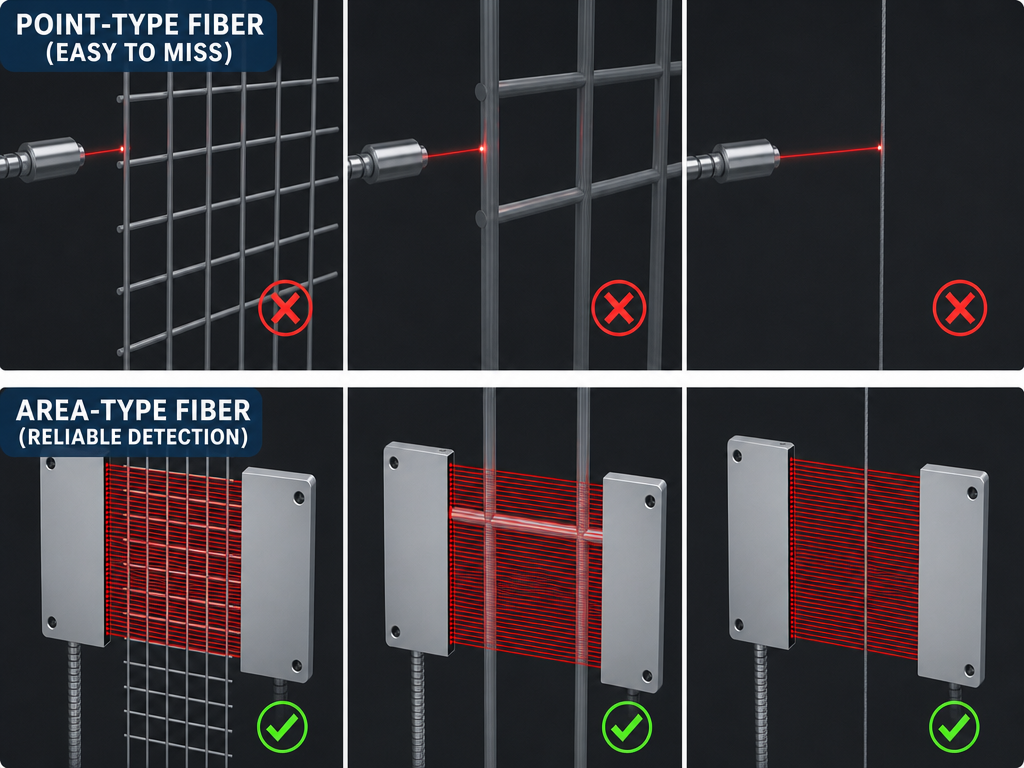
1. Why does the point-type optical fiber "miss detect"?
The light spot of point-type optical fibers (single-core or coaxial optical fibers) is very small, usually only a few millimeters or even just a few hundred micrometers. Its emitted light beam is like a very thin needle.
When the measured object is a fine wire or grid, if this "needle-like" light beam passes through the mesh or does not fall on the fine wire, the receiving end naturally cannot receive the signal. On a high-speed running production line, even a slight jitter of the fine wire or grid will cause the light spot to jump back and forth between "with object" and "through mesh", resulting in extremely unstable output signals and serious missed detection or false alarms. Using point-type optical fibers to detect grids is like using a flashlight to find a hair, aiming it and it can be seen, but if it is slightly off, it will be reflected onto the background.
2. The breakthrough solution for area-type (surface-type) optical fibers: bundled arrangement
To solve this problem, area detection-type optical fiber sensors (also known as surface-type optical fibers or wide-width optical fibers) emerged. Their core structure is completely different: internally, hundreds or thousands of extremely fine optical fiber strands are arranged in a matrix (bundled) to form a flat wide-width probe.
According to the arrangement of emission and reception, they are usually divided into collimated wide-width probes and diffuse reflection wide-width probes. This structure brings two fundamental advantages:
1. Wide-width light band, making gaps impossible to hide
The area optical fibers no longer emit a "point", but a wide-width light band (width can reach tens of millimeters to several tens of millimeters). When this light band sweeps over the grid or fence, the coverage area of the light band is much larger than the mesh area. Even if some light beams pass through the mesh, the remaining light beams will definitely hit the metal wire or yarn. As long as the receiving end detects the light beam being blocked, it can immediately output a signal, completely solving the missed detection caused by "light passing through the hole".
2. High tolerance, capturing extremely fine targets
For extremely fine wires or yarns, the advantage of area optical fibers lies in the "large surface area". If the fine wire has a slight positional jitter, as long as it remains within the coverage range of the wide-width light band, the sensor can stably capture the signal. For diffuse reflection type wide-width probes, as long as one of the fine wires is close to the probe surface, its reflected light can be captured by the receiving fiber bundle in the array.
3. Typical application scenarios
Textile and wire industry: yarn breakage detection, fine copper wire breakage monitoring. The wide-width light band can cover the entire wire reel, and as soon as the wire breaks, an alarm is triggered.
Metal processing: online detection of the presence or absence of punched metal nets, expanded nets, and filter nets. No longer worrying about the signal flickering caused by mesh holes.
Semiconductor and electronics: fine pins of lead frames, edge positioning of perforated thin plates.
Packaging and printing: fine marks on transparent or semi-transparent films, monitoring the area of non-woven fabric nets.
4. Selection and installation suggestions
When choosing area-type optical fibers, it is necessary to confirm whether the detection width of the probe is larger than the maximum mesh diameter or jitter range of the measured object; for collimated area optical fibers, it is necessary to ensure that the wide-width light band of the emission end and the receiving end are strictly aligned; if detecting extremely fine and reflective wires, it is recommended to pair with an optical fiber amplifier with high-precision digital filtering function to filter out the interference from the background mesh.
Summary: Point-type optical fibers are "single-point breakthrough", suitable for detecting solid small parts; while area optical fibers are "comprehensive coverage", specializing in objects with holes, gaps, extremely fine and prone to jitter. Choosing the right probe structure will naturally solve the problem of missed detections.
Rihuan Sensing offers a variety of specifications of area detection type (wide band / planar) optical fiber probes and accompanying optical fiber amplifiers. The wide array coverage is extensive, suitable for stable detection in scenarios prone to missed detections such as fine wires, grids, and textile yarns. Welcome to follow Rihuan Sensing to obtain professional fiber optic sensing selection and technical support.
