Today, Wuxi Rihuan Sensing Technology Co., Ltd. will introduce the Background Suppression (BGS) photoelectric sensor: Why does it perform better than ordinary diffuse reflection in detecting black workpieces?
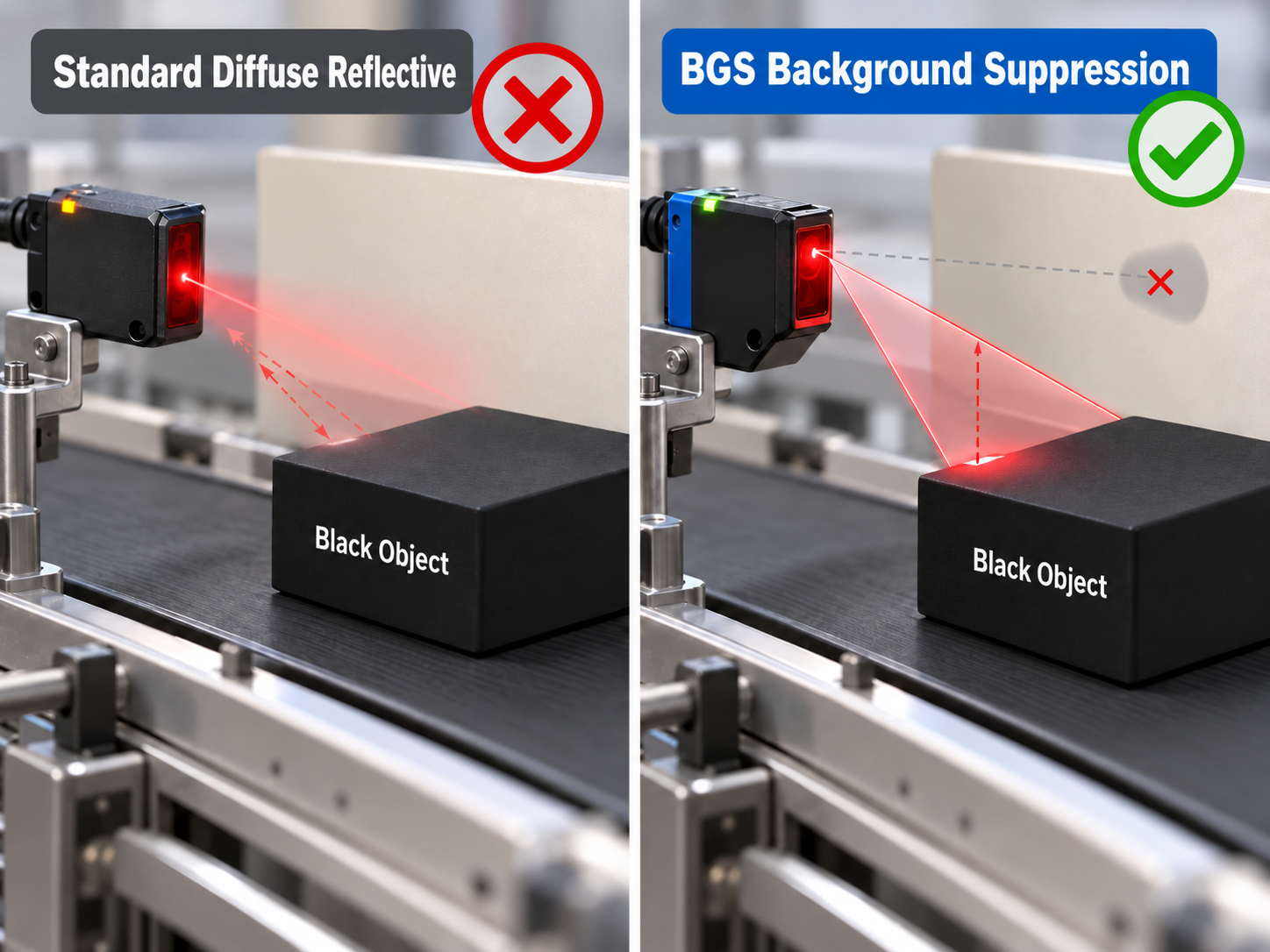
On industrial automation production lines, detecting black plastic parts, carbon black rubber, dark PCB boards and other light-absorbing workpieces is a classic challenge. When ordinary diffuse reflection photoelectric sensors encounter such workpieces, they often "work intermittently" - either there is no signal when the workpiece is in place, or they mistakenly trigger when there is no workpiece in the position. The fundamental reason why the BGS photoelectric sensor can work stably in this scenario is that it changes the basis of detection: from "how strong is the reflected light" to "how far is the object".
The dilemma of ordinary diffuse reflection: relying on "the intensity of reflected light", black workpieces are naturally disadvantaged
Ordinary diffuse reflection photoelectric sensors package the emitter and receiver in the same housing. Its logic for determining "whether there is an object" is simple: whether the received reflected light intensity exceeds the preset threshold. The whiter and brighter the object is, the stronger the reflected light is; the darker and more matte the object is, the weaker the reflected light is.
The trouble with black workpieces lies in their extremely low reflectivity. Black plastics, carbon black rubber, and other materials absorb most of the incident light, and the light signal returned to the receiver is extremely weak, not reaching the trigger threshold. The sensor "thinks" there is no object and directly misses the detection. More troublesome is background interference: if the black workpiece is behind a white conveyor belt or a reflective metal surface, the reflected light from the background is actually stronger than the workpiece itself. Ordinary diffuse reflection sensors "receive all the signals, but judge all wrong" - the strong background light is mistakenly recognized as the workpiece, while the real black workpiece is ignored due to the weak signal.
The solution for BGS: using "triangular distance measurement" to determine distance, not relying on the intensity of reflected light
The core principle of the BGS photoelectric sensor is optical triangulation distance measurement. Inside the sensor, there are two lenses: one is responsible for emitting the light beam, and the other is responsible for receiving the reflected light. The key point is that the receiver does not use a simple "light intensity detector", but a position-sensitive element (such as PSD, Position Sensitive Device) - it can sense the position where the reflected light spot falls on the receiving surface, rather than just the intensity of the light spot.
The geometric logic of triangulation is as follows: the emitted light beam and the receiving light path form a known triangular baseline. When the object distance is different, the angle at which the reflected light returns to the receiver will change, and the light spot will also move on the PSD. If the distance is close, the light spot leans towards one side; if the distance is far, the light spot leans towards the other side. The sensor calculates the position of the light spot to accurately determine whether the object is within the pre-set detection distance.
This means that the basis for BGS to determine "whether there is an object" is "whether the distance is correct", rather than "how strong is the reflected light". As long as the black workpiece enters the set distance range, regardless of how weak the reflected light it returns is, the light spot will fall on the corresponding position of the PSD and trigger the output. Even if the background object has extremely strong reflected light, as long as it exceeds the set distance, the light spot position is incorrect, and the sensor will ignore it.
The actual advantage of detecting black workpieces
The direct benefit brought by this principle difference is: the detection result is no longer "kidnapped" by the color and reflectivity of the workpiece.
Black workpieces are no longer missed: BGS does not rely on the intensity of reflected light, and black low-reflectivity workpieces can be stably triggered within the set distance, solving the problem of "no output at all" of ordinary diffuse reflection.
Background no longer causes false alarms: even if a white conveyor belt, metal tray, or reflective rack is located behind the workpiece, as long as it exceeds the set distance, its strong reflected signal will be automatically suppressed, and empty positions will not trigger falsely.
The detection distances for black and white workpieces are nearly consistent: Under the working logic of BGS, the effective detection distance for black and white workpieces has a very small difference. When the production line is reconfigured, there is no need to repeatedly adjust the sensors due to the change in workpiece color.
Selection and Usage Tips
The detection accuracy of BGS depends on the accuracy of the set distance. After installation, it is necessary to set the detection distance on the adjustment device (knob or teaching button) between the "workpiece surface" and the "background" through the sensor to ensure that the workpiece is triggered and the background is suppressed beyond the distance. For black matte workpieces, some BGS models can also use a blue light source. The reflection characteristics of blue light on black absorbing surfaces are better than traditional red light or infrared light, which can further improve the signal margin. In addition, the light spot size and detection distance of BGS need to be matched according to the actual size of the workpiece and the installation space to avoid large light spots causing unstable detection of small workpieces.
The Rihuan Sensor provides background suppression type (BGS) photoelectric sensors, which operate based on the triangulation principle, using distance rather than the intensity of reflected light as the detection basis. It is suitable for stable detection of low-reflective workpieces such as black plastics, dark rubber, and PCB boards, while effectively suppressing the interference of high-reflective backgrounds behind. The product supports adjustable detection distance and multiple output modes, and is suitable for the detection requirements of different production lines. Welcome to follow Rihuan Sensor to obtain professional BGS sensor selection and technical support.
