Today, Wuxi Rihuan Sensor Technology Co., Ltd. will introduce to you the key part in the limit protection of machine tools: how does the proximity switch work?
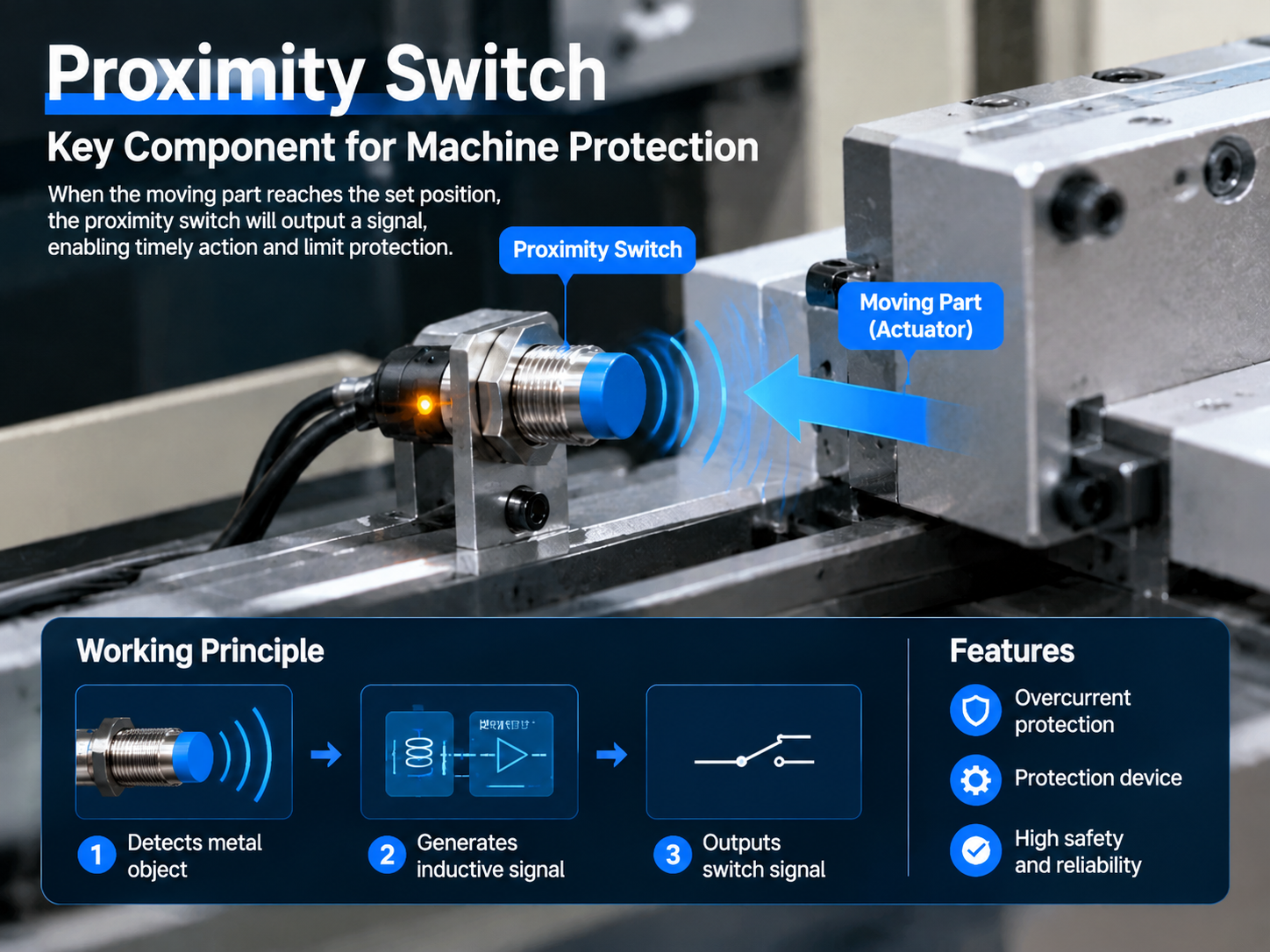
In the automated operation of industrial machine tools, the travel control of moving parts directly affects the safety and processing accuracy of the equipment. If the worktable exceeds the safe physical limit (i.e., over-travel) during operation, it is highly likely to cause mechanical collisions and even equipment damage. To achieve precise limit protection, the proximity switch plays a crucial role.
Based on the working principle of machine tool limit protection, let's break down how this system achieves the complete closed loop of "monitoring - feedback - shutdown".
1. System Core Components
A complete machine tool limit protection system usually consists of the following key parts:
Drive motor: As the power source, it drives the worktable to move along the guide rail in a straight line.
Moving worktable: The main body that performs processing actions, it needs to run within the set track.
Limit position (metal stopper): Installed at the extreme position of the worktable movement, it serves as the target object for triggering signals.
Installation bracket: Used to fix the proximity switch and allow engineers to adjust its installation position to precisely set the sensing distance.
Proximity switch: The core detection component, responsible for detecting whether the metal stopper is close in an non-contact state, and outputting an end-of-travel signal.
Controller: The "brain" of the system, responsible for receiving switch signals and issuing control instructions.
2. Work Process Analysis
How does the limit protection system step in when the machine tool starts running?
Step 1: The mechanism begins to move. The controller issues an instruction, and the drive motor starts, driving the moving worktable to move in the set limit direction.
Step 2: Approach the limit position. As the worktable moves, its edge metal stopper gradually approaches the proximity switch installed at the extreme position.
Step 3: Switch detects end of travel. When the metal stopper enters the sensing range of the proximity switch, the proximity switch quickly acts, detecting the stopper and outputting an electrical signal.
Step 4: Controller issues shutdown command. This signal is immediately transmitted to the controller of the machine tool. The controller, after logical judgment, instantly issues a "stop (STOP)" command to the drive motor.
Step 5: Complete protection and reset. The drive motor is powered off and braked, the worktable stops moving, successfully avoiding over-travel. At this point, the equipment enters a safe state, and the operator can manually or automatically reset after the situation is resolved.
3. Application Value
Applying proximity switches to machine tool limit protection has its core value in preventing problems before they occur. It not only effectively prevents hard mechanical collisions caused by over-travel of the equipment, protecting precision components such as screws and guides from damage, but also significantly improves the safety and operational reliability of the entire machine tool equipment. Since the proximity switch is non-contact detection, there is no mechanical wear, and it also has an extremely long service life.
Rihuan Sensor provides various specifications of inductive proximity switches, featuring fast response speed, high detection accuracy, and strong anti-interference ability, and is widely used in the limit detection and position control of various machine tools. Welcome to follow Rihuan Sensor to obtain professional sensor selection guidance and technical support.
