Today, Wuxi Rihuan Sensing Technology Co., Ltd.will introduce three core applications of color mark sensors: color matching, cutting, and presence/absence detection. How to choose?
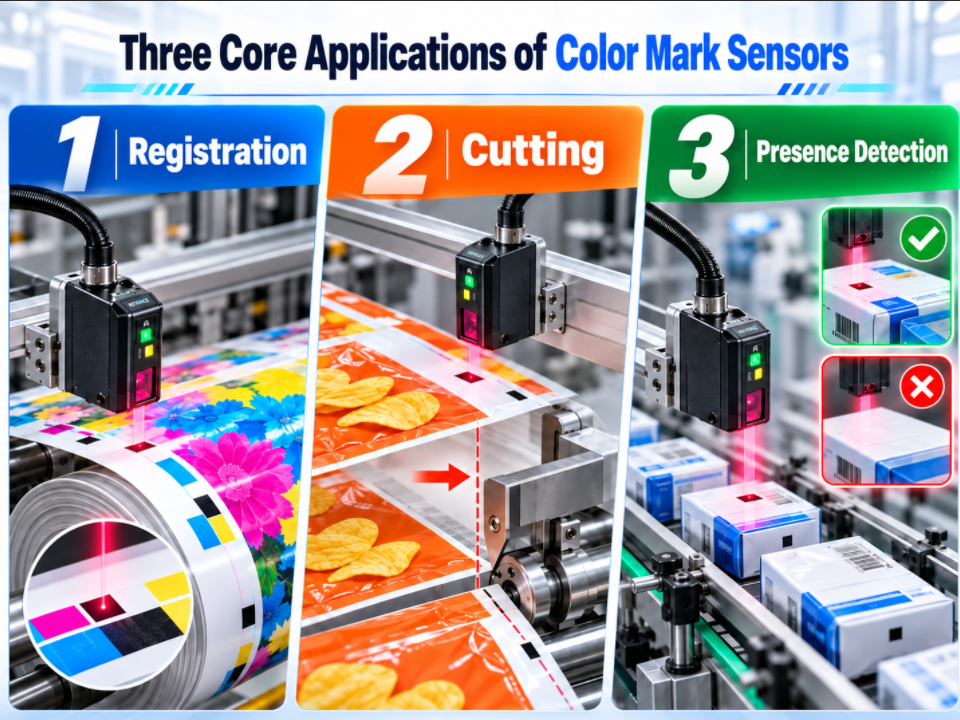
In the automated production lines of the packaging and printing industry, color mark sensors play a crucial role as "eyes". They output precise signals by identifying the contrast between the printed marks and the background color, which is the basis for achieving precise control. For different process stages, the selection focus of color mark sensors is completely different. In summary, it can be said: for color matching, speed is the key; for cutting, accuracy is the key; for presence/absence detection, contrast is the key.
1. Color matching detection: The core is "fast"
In multi-color printing processes, each color plate roller will print an exclusive color mark. The sensor needs to detect the position of these color marks in real time to ensure perfect alignment of multi-color offset printing and avoid ghosting or color deviation.
Selection points: The response speed must be fast. When the printing machine runs at high speed, the color mark flashes by, if the sensor's response time cannot keep up, it will cause missed detection, resulting in inaccurate offset printing. Therefore, a color mark sensor with high frequency response and microsecond-level response time must be selected.
2. Cutting positioning: The core is "accurate"
In the production of packaging films or label papers, the sensor triggers the cutting knife by recognizing the color mark to ensure that each packaging bag or label is cut at the correct position.
Selection points: The repeat accuracy must be high, and the response time must be much shorter than the time it takes for the color mark to pass. Only by leaving sufficient time margin can the timing of each triggered signal be highly consistent, thereby ensuring that the cutting length is exactly as required and reducing the scrap rate.
3. Label presence/absence detection: The core is "distinguish"
In the label printing or labeling process, it is necessary to confirm whether the label base paper has a mark or whether the product has a label.
Selection points: Select the light source based on the contrast between the label and the background. Some marks have very small color differences from the background color or have similar reflective rates. At this time, a sensor with multiple light sources (such as RGB) must be selected, by switching the light sources to find the one with the greatest contrast, so as to stabilize the identification.
In summary: Select a color mark sensor specifically for color matching when requiring high-speed tracking; select a high-precision model when requiring precise triggering; select a sensor with multiple light sources and high contrast when the color is difficult to distinguish.
Rihuan Sensing's color mark sensor series has microsecond-level ultra-fast response and supports one-click automatic learning (Teach-in) function, which can easily handle various complex backgrounds and marks. Whether it is high-speed color matching, precise cutting, or label detection, Rihuan Sensing can provide you with a complete packaging printing scenario adaptation solution. Welcome to follow Rihuan Sensing and obtain professional selection support.
