Today, Wuxi Rihuan Sensor Technology Co., Ltd. will introduce to us whether the "lens" of the photoelectric sensor can still be used even if it is scratched - the impact of the scratch on the detection.
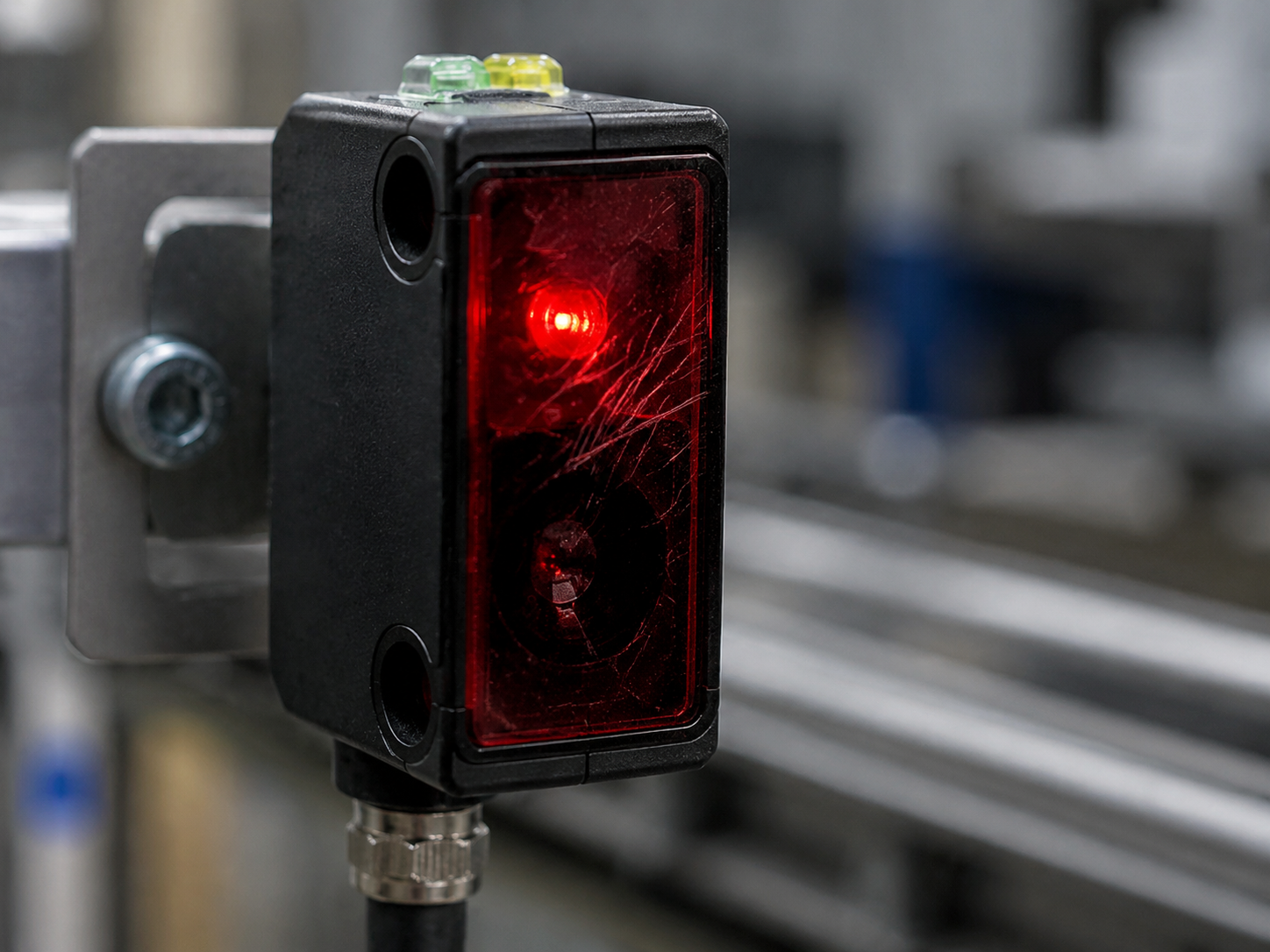
The lens of the photoelectric sensor is the "window" through which light enters and exits the sensor. Its condition directly determines the detection performance of the sensor. However, in industrial settings, lens scratches are quite common - during installation,Collision caused by tools, improper cleaning methods, and equipment vibration causing friction with the workpiece can all leave scratches on the lens surface. So, can a scratched lens still be used? The answer is: it depends. Minor surface marks may not affect its use, but deep scratches must be replaced.
1. Lens material determines scratch resistance
The lens materials used in photoelectric sensors are mainly two types: optical glass and optical plastic.
Optical glass lenses have high hardness and excellent scratch resistance, and their performance remains stable in high-temperature and high-humidity environments. However, they are costly and fragile. Some high-end sensors use sapphire sensing heads, which have extremely strong wear resistance and scratch resistance.
Optical plastic lenses (commonly made of PMMA polymethyl methacrylate or PC polycarbonate) are lightweight, inexpensive, and suitable for large-scale production. However, they have poor scratch resistance - their hardness is lower than that of glass, and they are prone to scratches and wear. In the FAQ of MURATA Manufacturing, it is clearly stated: "Lenses are optical components. Dirt and scratches can cause performance degradation. As they are plastic that is easily damaged, please be careful when using them."
On-site judgment: If the material of the lens is uncertain, check the product manual or the label. Glass lenses are usually labeled as "Glass lens", while plastic lenses are labeled as "Plastic lens" or "PMMA/PC". Glass lenses have a higher tolerance for minor scratches, while plastic lenses require more caution.
II. How does a scratch affect the detection performance?
The impact of lens scratches on photoelectric sensors mainly lies in two aspects:
Light scattering, signal attenuation
The scattered light generated by scratches on the surface of optical components will increase system noise and reduce contrast. Surface defects (scratches) will scatter light, causing stray light signals (or "offset currents") to be generated on the detector, which are superimposed on the actual reflection signals and may lead to abnormal signal amplitudes. For diffuse reflection type photoelectric sensors, some of the energy of the emitted light is scattered and lost when passing through the scratched lens, resulting in weakened light intensity reaching the target object; when the reflected light returns, it passes through the scratched area again, experiencing another scattering loss - under the double attenuation, the detection distance may significantly shrink.
2. Energy loss, detection range reduction
The deeper and wider the scratches are, the more severe the obstruction and scattering of the light path will be. Minor surface marks may have little impact on the light path, but deep scratches will cause a considerable proportion of the light energy to fail to pass through the lens normally. For collimated photoelectric devices, scratches on the transmitting lens will cause the light intensity to weaken, and scratches on the receiving lens will lead to a decrease in the receiving sensitivity - if there is a problem at either end, the effective detection distance will be shortened. The actual manifestation is: objects that could be stably detected before now have intermittent signals; the detection distance of 3 meters before is now insufficient at 2 meters.
III. How to determine if a replacement is needed?
Step 1: Visual inspection
Minor surface marks (thread-like fine lines): If the scratches are very shallow, occur rarely, and are not in the center area of the lens, they usually do not affect the use and can be left as is for observation.
Obvious deep scratches (visible grooves with the naked eye): If the scratch can be felt to have a significant depression with your fingernail, or if the width of the scratch exceeds 0.1mm, it is recommended to replace it.
Multiple scratches are densely distributed: Even if each individual scratch is not deep, the cumulative effect of multiple closely spaced scratches will result in a significant reduction of light energy.
Step 2: Function Testing
Visual inspection cannot fully replace functional verification. It is recommended to test according to the following steps:
Select standard test objects (such as standard whiteboards or test pieces with known reflectivity), and conduct occlusion tests at the midpoint of the sensor's nominal detection distance.
Check whether the sensor can output signals stably and reliably, and compare whether the detection distance has significantly shortened compared to before cleaning.
If the detection distance is shortened by more than 20% to 30% compared to the nominal value, or if the signal is intermittent and frequently gives false alarms, it indicates that the scratch has affected the performance. In this case, the lens or the entire sensor should be replaced.
Step 3: Cleaning Verification
Sometimes, what appears to be scratches on the surface may actually be oil stains or dust. First, use a lint-free cloth and isopropyl alcohol to gently wipe the surface of the lens. Then observe whether the performance has returned. If the performance returns to normal after cleaning, it indicates that it is a dirt problem rather than a scratch; if the problem persists after cleaning, it is confirmed as a scratch damage.
Special notice: It is strictly prohibited to wipe the lens with a cleaning agent containing abrasive substances, as this will further scratch the lens. Brushing may also leave scratches on the surface of the lens.
Four. Prevention is better than replacement
Rather than agonizing over whether the lens can still be used after it gets scratched, it's better to take preventive measures at the source:
Install protective covers or dust caps: Place a transparent protective window in front of the sensor to prevent scratches from occurring on the protective cover rather than on the lens itself.
Choose glass lenses or sapphire lenses: For harsh environments, prefer materials with better scratch resistance.
Standardize cleaning procedures: Use a dust-free cloth and isopropyl alcohol. Perform a single-directional gentle wipe, and avoid rubbing back and forth.
Avoid damaging the tools during installation: When installing and adjusting the sensor, be sure to prevent any tools, such as screwdrivers, from touching the surface of the lens.
Summary
Degree of scratch Usability Suggestion
Minor fine lines on the surface, not in the center area Usable Continue using, observe regularly
Visible scratches in the center area Cautious Perform functional tests, judge based on results
Deep scratches or multiple dense scratches Unusable Replace the lens or the entire sensor
If the performance still does not meet the standard after cleaning Unusable Must replace
The lens is the "eye" of the photoelectric sensor, and scratches are like "cataracts" - mild cases cause blurred vision, severe cases lead to total blindness. There is only one criterion: if the functional test fails, it must be replaced.
The photoelectric sensor series of Rihuan Sensing offers various options such as glass lenses and scratch-resistant coatings, catering to different working conditions. The products undergo strict optical performance testing before leaving the factory to ensure the lens surface is smooth and meets the standards. Welcome to follow Rihuan Sensing to obtain more reliable photoelectric detection solutions.
