Today, Wuxi Rihuan Sensor Technology Co., Ltd. will introduce to you how to handle the situation when the "key" of the security door lock is lost? - The replacement process of the actuator for the coded door lock.
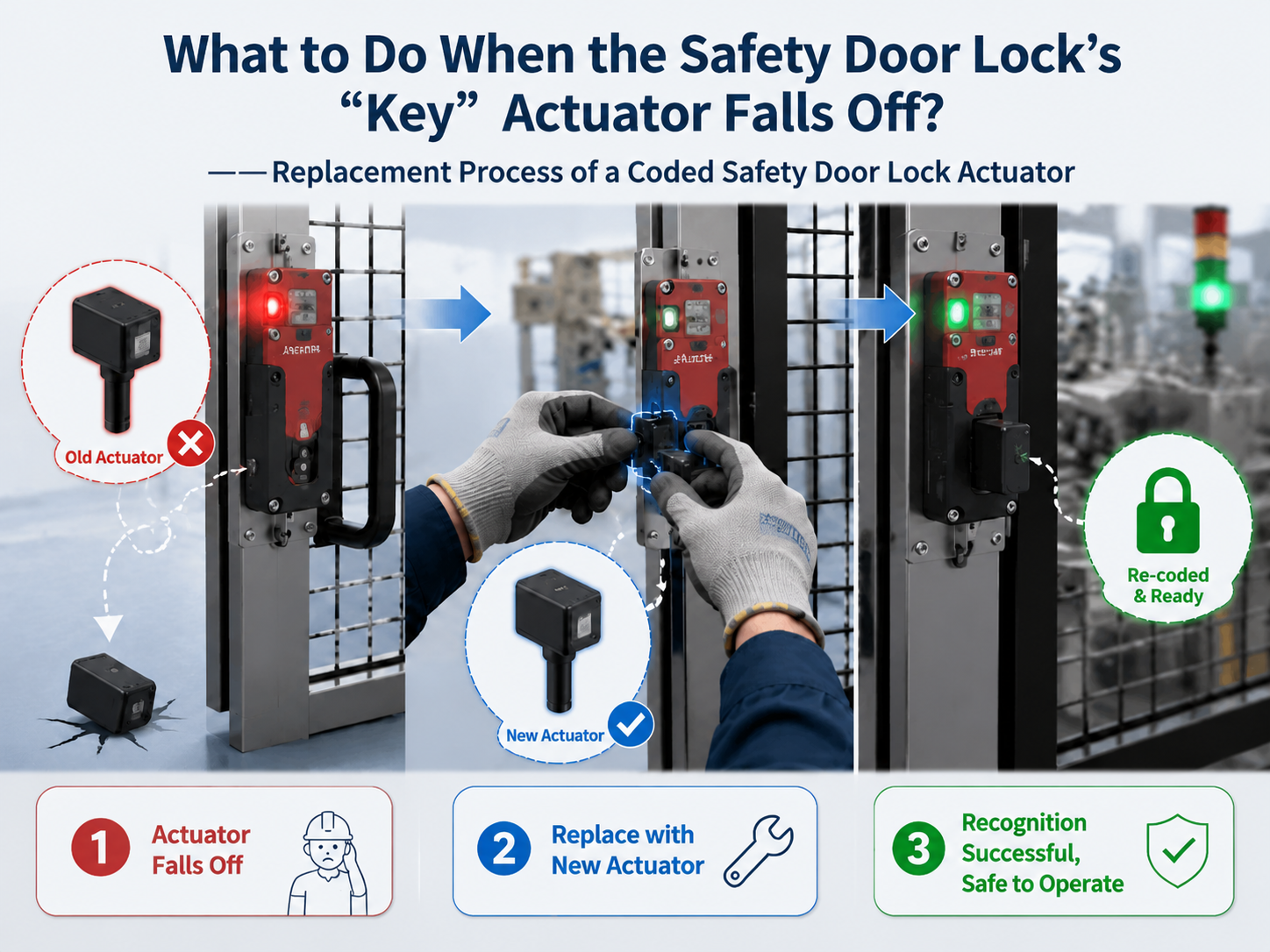
In industrial safety protection, coded safety door locks (such as RFID-coded locks or magnetic-coded locks) prevent tampering and bypassing by giving each actuator a "unique identity". However, in practical applications, there is a common problem: what if the actuator (equivalent to the "key" of the door lock) is lost?
The answer depends on which type of encoding you are using - the general encoding or the unique encoding (permanent encoding), and the processing method is completely different.
1. First, confirm the type of code
Currently, the coded security door locks available on the market usually offer two code modes:
Encoding mode Characteristics Anti-spoofing capability
General encoding (ordinary encoding) All actuators of the same model have the same encoding and can be used interchangeably Lower - Any actuator of the same model can open
Unique encoding (permanent encoding/complete encoding) Each actuator is one-to-one paired with the door lock body and cannot be replicated or replaced Highest - Only the unique actuator that is paired can pass the verification
Some brands also offer a complete encoding version that is in between the two, as well as a Unicode version that can be repeatedly learned.
II. Loss of universal coding type actuator: Replace immediately
If you are using a universal coding type safety door lock, the process is the simplest:
Operation Procedure:
Purchase the same model of spare actuators from the supplier.
Install the new actuator onto the safety door and ensure that the sensing surface is facing the main body of the door lock.
After installation, the door lock will function normally - no need for any code learning or re-pairing.
Applicable conditions: Only applicable to universal coding type door locks. The characteristic of these door locks is that all the actuators of the same model have the same coding and can be used interchangeably.
III. Loss of the unique code (permanent code) type actuator: Re-teaching is necessary
If a unique code type (also known as permanent code or complete code) actuator is used, the actuator is one-to-one bound to the main body of the door lock. If it is lost, simply purchase a similar model actuator and install it, but the door lock will not recognize it - because the codes do not match.
Operation Procedure:
Step 1: Confirm that the door lock supports reprogramming.
The unique code type door locks of different brands and models have different support methods for replacing the actuators:
One-time permanent coding: The actuator and sensor are permanently bound at the time of factory shipment or during the first teaching session. The learning process can only be completed once. For this type of actuator, if it is lost, the entire set of door locks (sensor + actuator) must be replaced.
The only repeatable encoding (Unicode): New actuators can be re-bound with sensors through the learning process, and this process can be repeated any number of times. This type only requires purchasing new actuators and re-teaching.
Step 2: Purchase the same model actuator
After confirming that the door lock supports reprogramming, purchase a spare actuator of the same model from the supplier (some manufacturers provide each actuator with a unique RFID code).
Step 3: Follow the instructions to re-teach/learn the coding process.
After installing the new actuator onto the safety door, it is necessary to perform a re-teaching (Teach-in/Learning) according to the product manual, so that the main body of the door lock can "remember" the code of the new actuator.
The operation methods of different brands vary. Common teaching methods include:
Enter the teaching mode by pressing the button or using the dip switch on the door lock body.
Through dedicated teaching tools or software
Trigger the learning process through a specific power-on sequence (such as completing a specific operation within a certain period of time)
Step 4: Function Verification
After the teaching process is completed, functional verification must be carried out (please refer to the fourth part below for details).
Key tip: The teaching process usually has strict time window restrictions (such as completing within 15 seconds). If the time limit is exceeded, you may need to start over. Make sure to read the manual thoroughly before operating.
IV. Safety verification requirements after replacing the actuator
Regardless of the type of code, after replacing the actuator, the following verification steps must be completed:
Mechanical installation verification
Ensure that the actuator is aligned with the sensing surface of the door lock body and that the installation position is correct.
Confirm that the fixing screws have been tightened, so that the actuator will not loosen due to vibration.
Ensure that the actuator can fully reach its position when the door is closed.
2. Electrical Function Verification
Close the safety door and confirm that the door lock indicator light shows the "locked" state.
Open the safety door and confirm that the equipment will immediately shut down.
Repeat the door opening and closing test at least three times to ensure that the signal is stable and without any interruption.
3. Safety loop verification
Confirm that the contacts of the safety relay are functioning properly.
Confirm that the emergency stop/safety stop function of the equipment is functioning properly.
If the door lock supports the EDM (External Device Monitoring) function, confirm that the external device monitoring is functioning properly.
4. Recording and Archiving
Record the date of replacing the actuator, its model, the operator, etc. in the equipment maintenance ledger.
If it is a unique coding type, record the coding information of the new actuator.
V. How to prevent the executioner from being lost? Preventive measures:
When purchasing, buy an extra 1-2 sets of backup actuators, especially for the ones with unique codes (please confirm if they support reprogramming).
Store the backup actuators in the designated location (such as the tool cabinet) and keep a record of them.
Set up actuator brackets near the safety door and develop the habit of "returning to the original position after use"
For the frequently opened and closed security doors, consider using non-contact security door locks (which do not require physical insertion of the actuator)
Summary
Encoding type Handling after the actuator is lost Whether re-teaching is required
General encoding Replace with the same model actuator directly No need
Unique encoding (relearnable) Purchase the same model actuator + re-teach Must
Unique encoding (one-time binding) Replace the entire set of door locks Cannot be replaced individually
If the actuator is lost, first check the encoding type before taking action. For general encoding type, just replace with a new one. For unique encoding type, re-teaching is required - install it without learning, the door lock won't recognize it, the safety circuit won't be disconnected, and the equipment won't stop.
Rihuan Sensing offers a full range of coded security door locks, including both universal coding and unique coding modes. The products comply with the requirements of EN ISO 14119 standard. If you need guidance on actuator replacement or technical support, please feel free to contact Rihuan Sensing.
