Today, Wuxi Rihuan Sensor Technology Co., Ltd. will introduce how to verify the installation of safety grating. Conduct one-by-one beam tests once a month, and don't miss any.
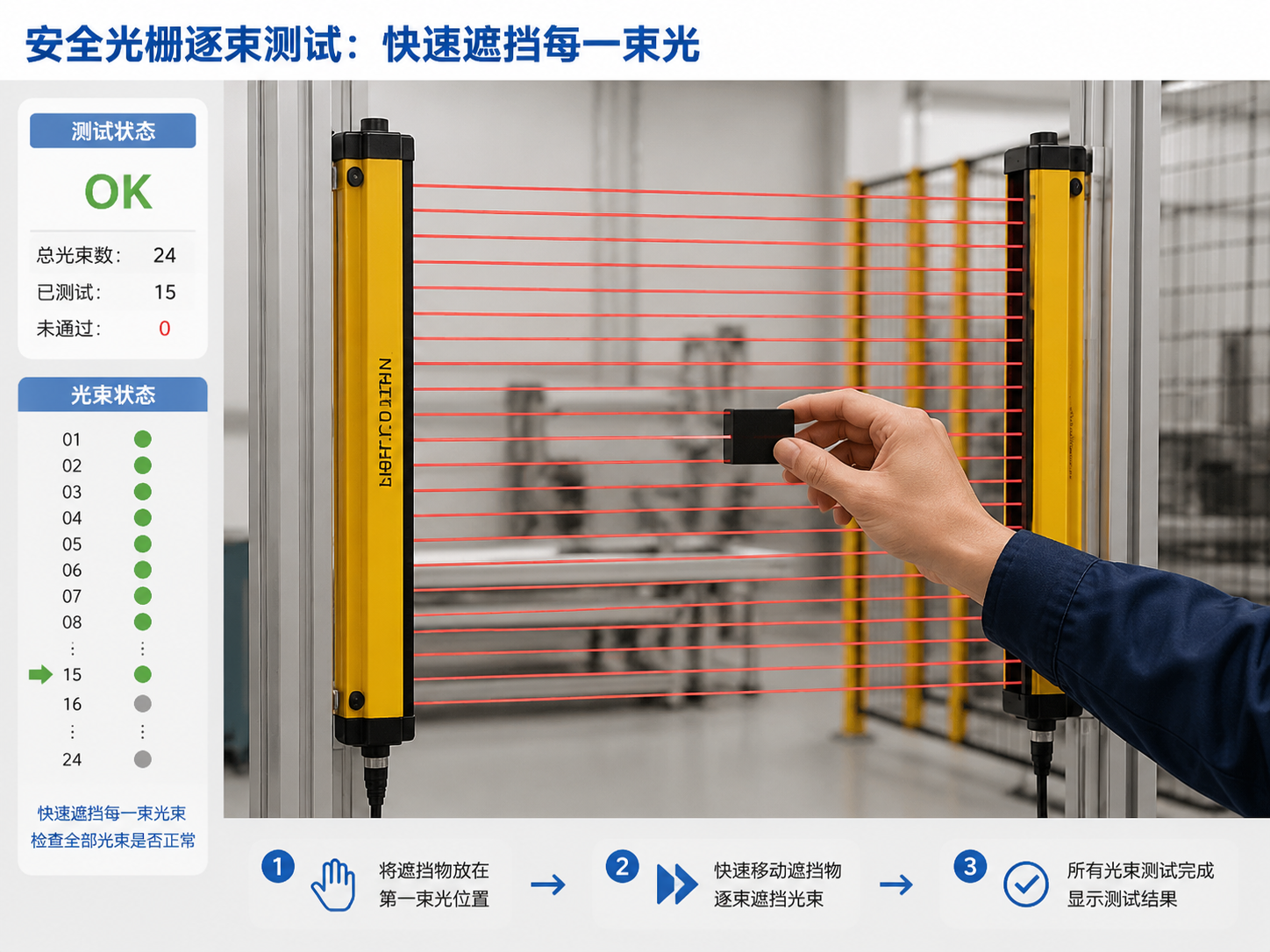
After the safety grating is installed and put into use, many users consider that the indicator light being on and the equipment operating normally means it is "working properly". However, the indicator light being on only indicates that the grating is powered on and the light path is unobstructed, but it does not prove that each beam of light can reliably trigger the stop mechanism when it is blocked. The only effective verification method is to conduct blocking tests one by one for each beam of light.
1. Use the correct test rod, with a diameter that matches the resolution.
The function of the test rod is to simulate the entry of human body parts (fingers, palms, or arms) into the dangerous area, to verify whether each beam of light from the grating can respond normally.
Test standard: The diameter of the test rod must be consistent with the resolution of the grating.
Raster resolution is 14mm → Use a test rod with a diameter of 14mm
Resolution of 20mm → Use a 20mm test rod
Resolution of 30mm → Use a 30mm test rod
If the diameter of the test rod is smaller than the resolution of the grating, it may cause the beam to be blocked but still not trigger (because the resolution is not high enough); if the diameter of the test rod is too large, it cannot simulate the real risk, and both situations will result in invalid test results. The test rod is usually a standard metal cylinder with a smooth surface without burrs, and it can be obtained from the grating supplier.
II. Individual Beam Testing: From top to bottom, not a single beam should be missed.
The specific operation steps are as follows:
Place the equipment in its normal operating condition (the grating is in the light-passing state and the indicator light is green).
Starting from the topmost beam of the light curtain, quickly block the first beam with a test rod.
Observe whether the equipment immediately stops operating, and check if the grating indicator light changes from green to red (or goes out).
Remove the test probe and confirm that the equipment can reset and restart normally.
Test each beam of light sequentially downward until the bottom, and each beam must be tested individually.
Key criteria for judgment:
Pass: The equipment stops immediately when any beam of light is blocked, and returns to normal operation after the obstruction is removed.
Non-compliant: The equipment continues to operate even after a certain beam of light is blocked → The corresponding beam might be blocked (by human short-circuiting), the transmitter or receiver's corresponding channel might be damaged, or the optical axis might not be aligned properly, resulting in the signal not being received effectively. The equipment must be immediately shut down for troubleshooting, and it shall not be put into use before the fault is resolved.
III. Why can't only one beam be tested?
Some sites, in an attempt to save time, simply use a testing rod to roughly block the central beam and assume that everything is fine once the equipment stops. This approach poses obvious safety hazards:
Each beam of light in the grating has its own independent emission and reception channels. The normality of a certain beam of light does not imply the normality of all the beams.
The light beams at both the upper and lower ends are most prone to being displaced or damaged due to mechanical collisions.
If a certain beam of light happens to be blocked or malfunctioning, and its location is outside the scope of regular testing, this area will be completely unprotected.
IV. How often should the test be conducted?
The frequency of the test should be determined based on the specific environment and usage conditions:
Normal operating conditions (with less dust, less vibration, and a clean environment): At least once a month.
Severe operating conditions (high dust content, heavy oil contamination, intense vibration): It is recommended to perform this inspection once a week.
After the equipment has been repaired or the grating has been reinstalled: A complete beam-by-beam test must be conducted immediately. Only after it is found to be qualified can production be resumed.
It is recommended that each test result be recorded in the equipment maintenance ledger, including the test date, the tester, the test result, and the handling of any abnormalities, to facilitate traceability. Some industry standards (such as GB 4584 "Technical Conditions for Light-Activated Safety Devices for Press Machines") also have clear regulations on the regular inspection of safety gratings. Enterprises should comply with these standards.
V. Summary
Project Requirements
Test rod diameter Consistent with the resolution of the grating
Test range All beams, from the top to the bottom, detected one by one
Passing criteria Device stops immediately when blocked, and returns to normal after removal
Normal operating conditions At least once a month
Adverse operating conditions Suggested once a week
After maintenance/reinstallation Re-tests must be conducted
One-by-one testing is not an option but a necessary measure to ensure that the safety grating truly functions. The failure of one beam could render the entire protective barrier ineffective.
