Today, Wuxi Rihuan Sensor Technology Co., Ltd. will introduce to you how to select the "spot size" of photoelectric sensors. Both large and small spot sizes have their own unique applications.
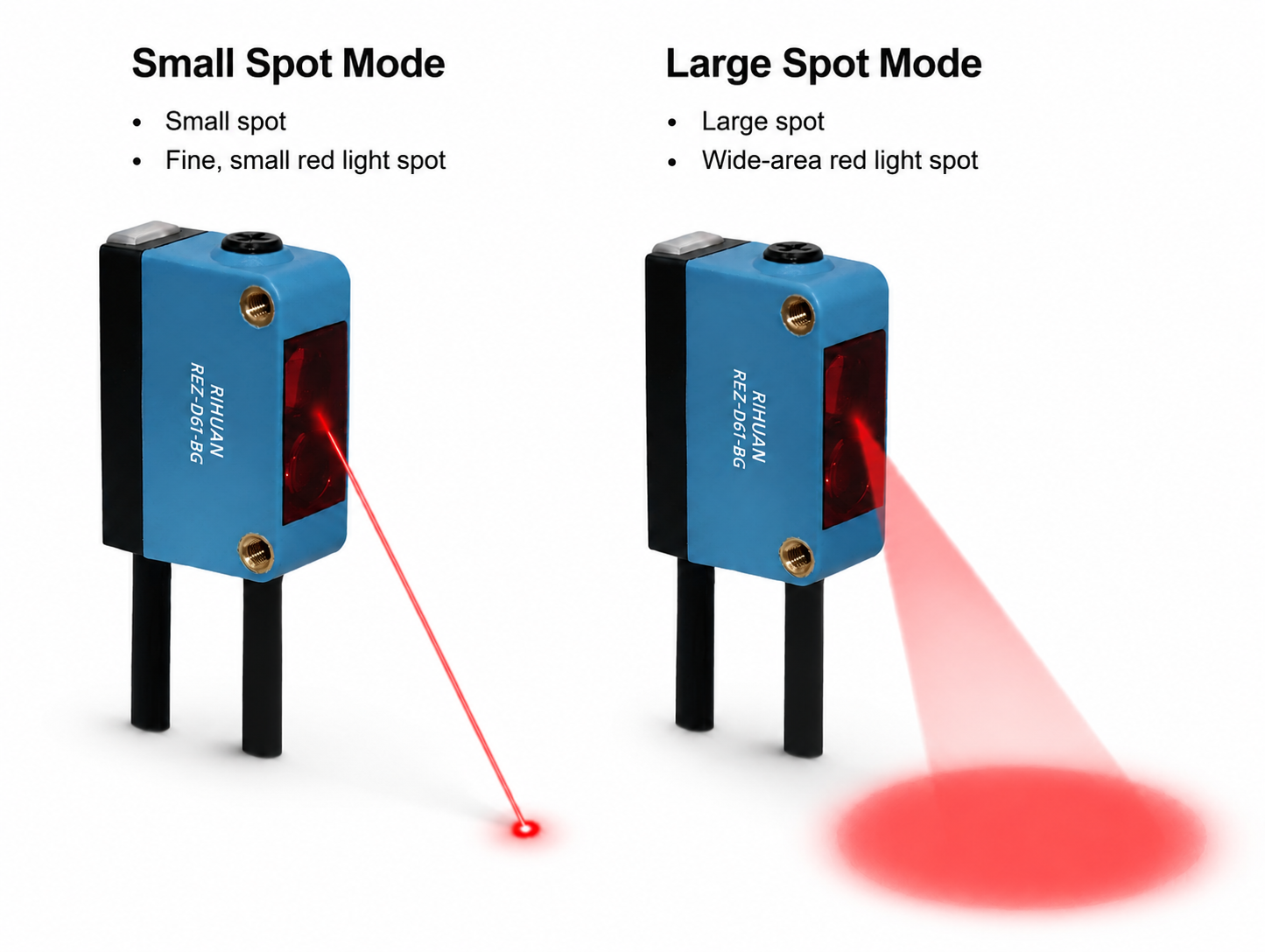
The spot size refers to the diameter or size of the light spot formed by the light emitted by the photoelectric sensorwhen it is projected onto the surface of the measured object. It is not a fixed value but a parameter that varies with the detection distance. The spot sizes of different models vary greatly - small spots can be as small as micrometers, suitable for precise positioning; large spots can reach tens or even hundreds of millimeters, suitable for covering large areas of targets.
Choosing the wrong spot size may cause small objects to be "overwhelmed" by the spot and unable to be recognized, or it may result in signal fluctuations due to the spot being too small to cover the ups and downs of the rough surface. The following are the selection guidelines.
1. Small spot: High precision, but requires strict installation conditions Feature:
The light spot has a small diameter and can precisely align with tiny targets.
The detection accuracy is high, and it can distinguish even the slightest positional deviations.
High requirements are placed on the installation angle and the stability of the support - any slight deviation of the light spot will cause it to lose its target.
Applicable scenarios:
Detection of small objects, such as counting electronic components and detecting the proper positioning of chip pins;
Precise positioning and edge detection, such as label position verification and object contour recognition;
Measurement of positional deviations of small objects.
Limitations:
If the surface of the object being measured has small depressions and protrusions, the small light spots can accurately reflect these variations, but at the same time, they are also very sensitive to vibrations and installation errors.
When the target is shaky or there is an installation error, the light spot is prone to脱离 the detection surface and the signal becomes unstable.
2. Large Spot: High fault tolerance, but not sensitive to small objects Feature:
The light spot has a large diameter and covers a wide area.
Even if the object moves slightly or shakes, the light spot can still cover the target, demonstrating strong fault tolerance.
The requirements for the installation angle are relatively lenient.
Applicable scenarios:
Detection of large objects, such as the goods passing on the conveyor belt;
Rough or textured surfaces, such as metal plates and wood processing inspections;
In situations with significant vibrations, such as for material detection on vibrating conveyors.
Limitations:
It is insensitive to small objects, and small objects are easily "overwhelmed" by large light spots.
It cannot be used for precise positioning or edge detection - the light spot coverage area exceeds the boundary of the target, and the signal cannot accurately reflect the position of the object.
III. Effects of Different Spot Sizes
Comparison item Small spot Large spot
Accuracy High, up to micrometer level Low, above millimeter level
Anti-shake ability Weak, prone to losing target Strong, allowing larger displacement
Installation accuracy requirement High Low
Suitable targets Small objects, edges, positioning Coarse objects, rough surfaces
Not suitable For occasions with large shaking and unstable installation For fine objects, precise positioning
IV. Spot size will change with distance
It should be noted that: The spot size is not fixed. The spot size of most photoelectric sensors will gradually increase (divergent beam) as the detection distance increases (for most types), and some specially designed beams maintain a constant size within a specific distance range.
When selecting the model, one should refer to the spot size-distance curve diagram in the product manual and confirm whether the spot size meets the on-site requirements at the installation distance.
V. Selection Rules
Measure small, measure precise, measure positioning → Select small light spot
Measure large, measure coarse, measure jitter → Select large light spot
If the on-site conditions are uncertain, it is recommended to conduct a verification test using the actual object to be measured before installation, or consult the supplier for the data on the spot size.
The photoelectric sensor series of Rihuan Sensing covers various light spot sizes and provides detailed light spot distance diagrams for selection reference. Welcome to follow Rihuan Sensing to obtain professional photoelectric detection solutions.
