Today, Wuxi Rihuan Sensing Technology Co., Ltd. will introduce the distance measurement principle of laser displacement sensors: thetrigonometric method vs the time method (TOF method).
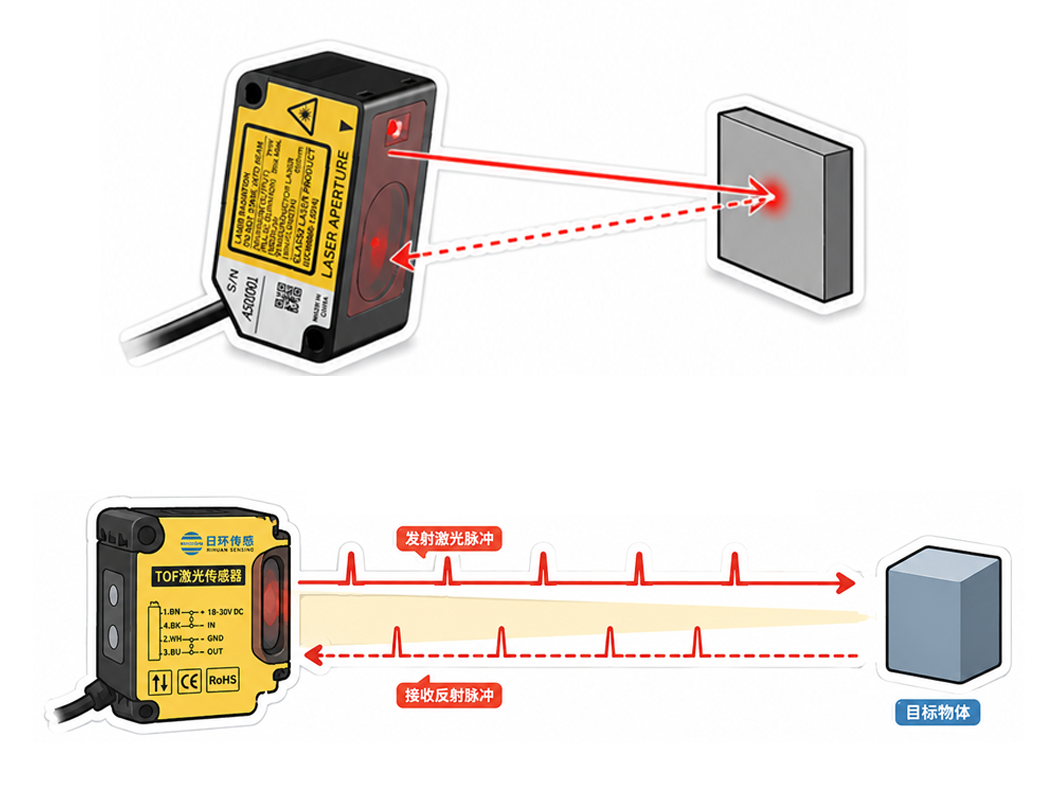
In industrial measurement and automatic control, laser displacement sensors are widely used for non-contact distance detection. According to the different ranging principles, they are mainly divided into two types: the triangulation method and the time-of-flight method (TOF method). Choosing the wrong principle may cause the equipment to fail to meet the actual measurement requirements.
I. Triangulation Method
Working Principle: The laser emits a beam of laser to illuminate the surface of the measured object. The diffuse reflection light from the object's surface passes through the receiving lens and is imaged onto the photosensitive element (such as CMOS or PSD). When the object moves, the position of the imaged spot on the photosensitive element changes accordingly. The distance of the object's movement is calculated through the geometric triangle relationship.
Feature:
Measurement of distance: Short distances, usually ranging from a few millimeters to a few meters;
Measurement accuracy: High, capable of reaching the micron level (μm);
Resolution: Superior to the TOF method.
Typical application:
The height measurement of electronic components (such as the coplanarity of chip pins);
Measurement of the thickness of workpieces (such as metal plates, glass, films);
Vibration measurement, monitoring of minute displacements.
Applicable scenarios: Situations where high precision is required, the measurement range is relatively short, and the surface of the measured object has sufficient diffuse reflection characteristics.
II. Time-of-Flight Method (TOF Method)
Working principle: The sensor emits a laser pulse towards the measured object. The pulse is reflected back after reaching the object, and the sensor receives the echo and measures the time difference between emission and reception (or measures the phase difference of the continuous wave modulated signal). The distance is calculated based on the speed of light.
Feature:
Measurement of distance: Long, ranging from a few meters to several tens of meters or even hundreds of meters;
Measurement accuracy: Relatively low, typically at the millimeter level (mm).
Not affected by the color or material of the object (within the reasonable reflection range).
Typical application:
Level measurement of the silos and towers;
Positioning control for cranes and hoists;
Stacking and positioning for large-scale warehousing and logistics.
Applicable scenarios: Situations requiring long-distance measurement, with a moderate precision requirement (acceptable to the millimeter level), and in environments with strong light or where there are dust, steam, or other disturbances.
III. How to Choose: Summary in One Sentence
Principle Measurement Distance Accuracy Typical Scenarios
Triangulation Method Short (mm to several meters) High (micron level) Electronic manufacturing, thickness measurement, vibration
TOF Method Long (several meters to hundreds of meters) Lower (mm level) Level measurement, vehicle positioning, warehousing
Selection Principles: Choose the triangulation method if high accuracy is required; choose the TOF method if long distance is needed. Selecting the wrong principle will either result in no target being detected or the measured data not meeting the process requirements.
Rihuan Sensing offers a series of laser displacement sensors based on two principles: the triangulation method and the TOF method. These sensors can meet various measurement distances and accuracy requirements, and are available for customized selection. Welcome to follow Rihuan Sensing to obtain professional ranging solutions.
