Today, Wuxi Rihuan Sensor Technology Co., Ltd.will introduce to you the techniques for determining the quality of slot-type photoelectric switches, and teach you how to handle it quickly.
In modern production fields such as automatic monitoring, automatic control, and automatic counting, the application of photoelectric switches is becoming increasingly widespread. And the slot-type photoelectric switch, with its standard concave-shaped structure and safe and reliable characteristics, has become the preferred equipment for monitoring scenarios with rapid changes in production. Judging the quality of the slot-type photoelectric switch directly affects the smoothness and accuracy of the production process. Rihuan Sensing, as a professional brand specializing in sensing technology, based on its many years of industry experience and product development practice, has compiled a set of simple and efficient judgment methods for everyone.
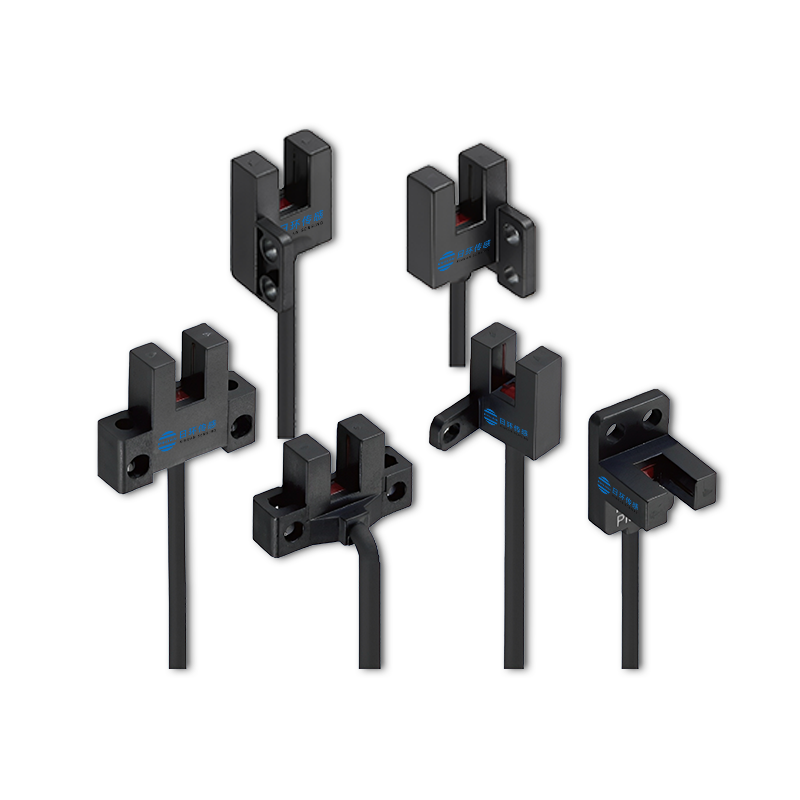
The core working principle of the slot-type photoelectric switch (also known as "concave-type photoelectric switch") is to form an optical axis between the photo-emitting tubes and the photo-receiving tubes on both sides of the concave slot. When the measured object blocks the optical axis, a switch signal is generated. We can quickly test its performance using two multimeters according to the following steps. This method is applicable to the circular sensing slot-type photoelectric switch and most similar products on the market. It is convenient to operate and has a high accuracy rate.
First, prepare two multimeters. Set the first multimeter to the R×100 range and use the two probes to measure the forward and reverse resistances of the switch's C and E terminals. Under normal circumstances, the resistances should be infinity. If the resistance values are abnormal, it indicates that the switch is damaged or its performance has declined. It is not recommended to continue using it. Then, keep the black probe of the first multimeter on the C terminal and the red probe on the E terminal, and set the second multimeter to the R×1 range. Place the black probe on the A terminal and the red probe on the K terminal. Use the internal battery voltage of the second multimeter to drive the phototransistor to work. At this time, observe the first multimeter. The resistances of the C and E terminals should quickly drop to a smaller value. After removing the probes from the A and K terminals, the resistances of the C and E terminals should immediately return to infinity, which is the basic characteristic of a functioning switch.
If the black probe of the second multimeter is connected to the K terminal and the red probe is connected to the A terminal, and the resistances at the C and E terminals remain infinitely large, then it can be preliminarily determined that the slot-type photoelectric switch is basically normal. For further verification, you can switch the multimeter connected to A and K terminals to the R×10 or R×100 range. At this time, the conduction resistance at the C and E terminals will gradually increase — this is because the higher the range of the multimeter's electric resistance, the smaller the output working current, and the current flowing through the photoelectric emitter tube decreases, the infrared emission ability weakens, and thus the conduction resistance of the photoelectric receiver tube increases. This phenomenon can further prove the stability of the switch performance. It should be noted that if a pointer-type and digital multimeter are used for testing together, it is recommended to connect the digital multimeter to the C and E terminals and the pointer-type multimeter to the A and K terminals to avoid the microcurrent provided by the digital multimeter being insufficient to drive the emitter tube to work normally.
Rihuan Sensing has always been dedicated to providing high-quality and highly stable slot-type photoelectric switches for various industries. Its products are strictly manufactured in accordance with industry standards and can maintain excellent performance in various complex production environments. Through these methods, not only can the working status of Dayring Sensing's slot-type photoelectric switches be quickly diagnosed, but also it can provide a reference for the detection of other brand products. If you encounter any questions during testing or use, you can contact the Dayring Sensing technical support team at any time. We will arrange professional engineers to provide you with free consultation services to help you efficiently solve the sensor equipment problems in your production.
