Today, Wuxi Rihuan Sensor Technology Co., Ltd. will introduce to you how to connect the "reset button" of the safety photoelectric barrier. — The difference between manual reset and automatic reset and the safety compliance requirements.
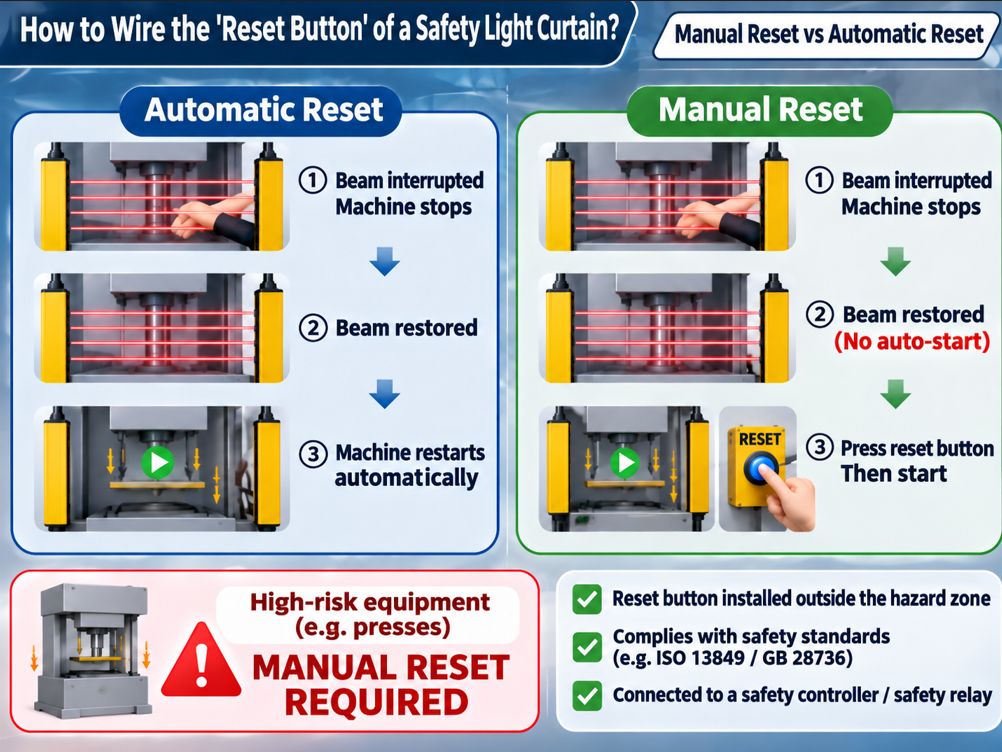
When the safety photoelectric barrier is blocked, the equipment stops. When the blocking object is removed and the photoelectric curtain resumes light transmission, should the equipment "start by itself" or must someone press the reset button to restart? This seemingly simple choice directly relates to the personal safety of the operator.
1. Two reset modes: Automatic reset and manual reset
The reset logic of the safety photoelectric barrier is determined by the "interlock function" inside the product, and it can usually be selected through wiring or parameter configuration.
Automatic reset (Auto Reset): When the photoelectric curtain resumes light transmission, the safety output (OSSD) immediately turns on, and the equipment can start immediately. This mode is suitable for scenarios where people cannot enter the area between the photoelectric curtain and the dangerous point - because people cannot enter, the photoelectric curtain turns on and starts without harming anyone.
Manual reset (Manual Reset): When the photoelectric curtain resumes light transmission, the safety output remains off (OFF), and the equipment will not automatically start. The operator must press the reset button installed outside the dangerous area for the safety output to be connected and the equipment to be allowed to restart. The safety photoelectric barrier product manual of Panasonic clearly states: When performing manual reset, even if the light enters, the control output will not automatically become ON, it must be through the reset input operation to be connected.
2. Why must high-risk equipment use manual reset?
For equipment such as punch presses, shearing machines, and bending machines, there is a fatal risk scenario: the operator's hand or body has entered the dangerous area, but the photoelectric curtain happens to resume light transmission (for example, the operator is squatting under the photoelectric curtain, and the body is not blocking the light beam). If at this time the equipment automatically resets and starts, it will cause serious injury.
The role of manual reset is to force an "人工确认" insertion. The reset button must be installed in a position where the entire dangerous area can be clearly observed and outside the dangerous area. Before pressing the button, the operator must use their eyes to confirm that there is no one in the dangerous area. This prevents the situation of "the person is still inside, but the equipment starts by itself" through the process.
The national standard has clear requirements for photoelectric protection devices used in press machines: when the photoelectric curtain is blocked and the slider stops, even if the human body withdraws and the light beam resumes transmission, the device should remain in the blocked state and the slider cannot resume operation. It must press the reset button for the slider to start again. The relevant technical specifications in the World Trade Organization documents also stipulate that the reset control device should be placed in a position where the dangerous area can be clearly observed, and no more than one reset device should be installed in each protection area.
3. How to connect the reset button?
Taking the Panasonic SF4C series as an example, the wiring method of the reset button depends on the output type of the photoelectric barrier (PNP or NPN) and the selected reset mode:
Select manual reset:
PNP output type: Connect the "reset input line" (usually light purple or pink) to +V (positive power supply).
NPN output type: Connect the "reset input line" to 0V (negative pole).
Select automatic reset:
Keep the "reset input line" open (no signal connected).
The reset button itself is usually a normally open (NO) button, with one end connected to the reset input line and the other end connected to the corresponding power polarity. When the button is pressed, the reset input line is short-circuited to +V or 0V, and the photoelectric barrier detects this signal, and the safety output is connected. When the button is released, the photoelectric barrier remains in operation until it is blocked again.
It should be noted that the reset terminals and wiring methods of different brands of photoelectric barriers may be different. Before wiring, be sure to consult the product manual of the corresponding model to confirm the terminal definitions.
4. Selection and usage reminder
For high-risk equipment, manual reset is preferred. If the safety grating itself supports two modes, in high-risk situations such as stamping and shearing, it is essential to configure it for manual reset through wiring, and ensure that the reset button is installed outside the hazardous area in a position with good visibility.
Automatic reset cannot be used in hazardous areas accessible to personnel. Automatic reset is only applicable in situations where "a person cannot enter between the light curtain and the hazardous point". If personnel may be trapped in the hazardous area, automatic reset is like a time bomb.
The reset button cannot replace the safety grating itself. The reset input terminal is clearly defined and compatible with different output types of PNP/NPN. The product complies with the IEC 61496 safety standard and is suitable for scenarios requiring safety interlocks such as stamping equipment and automated production lines. If you need guidance on reset wiring or selection support, please follow up with Rihuan Sensor.
