Today, Wuxi Rihuan Sensing Technology Co., Ltd. will introduce to you what the "hysteresis" of proximity switches is - and why the switch doesn't reset even after an object has moved away?
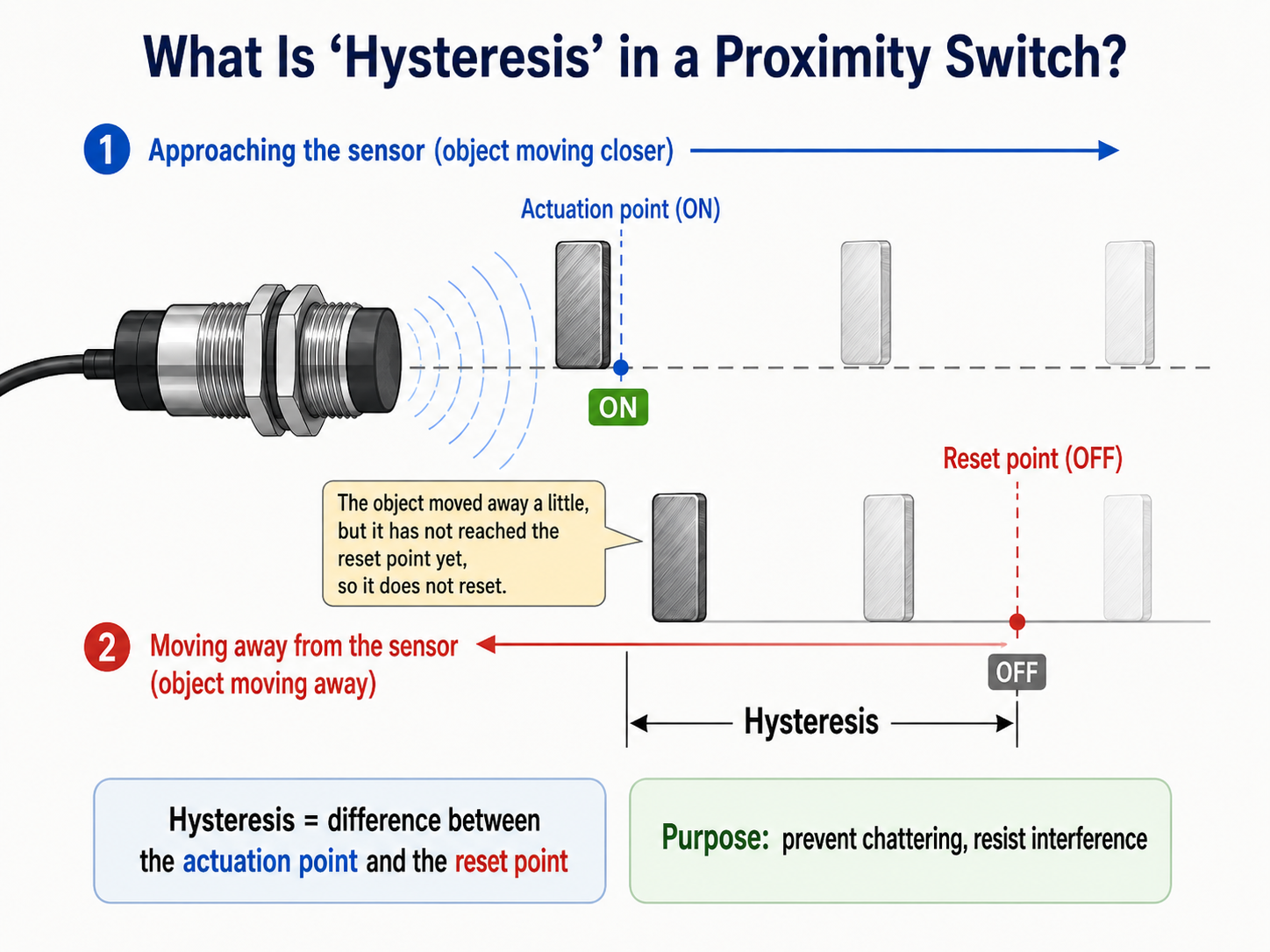
In industrial settings, many users have encountered such situations: when a metal object approaches a proximity switch, the switch acts sensitively; but after the object leaves, the switch doesn't reset promptly, as if it "reacted half a beat too late". Some think the switch is broken, while others believe the "lag" is too severe - but neither is the case. The phenomenon is actually related to a very important design parameter of proximity switches: hysteresis (also known as lag or differential distance).
1. What is hysteresis?
Hysteresis, also known as lag or differential distance, is the difference between the action distance and the release distance of the proximity switch.
Action distance: When an object approaches the detection surface of the proximity switch from a distance and the switch just acts (outputs ON) when the distance between the detected object and the detection surface is just right.
Release distance: When the object leaves the detection surface, the switch changes from acting to releasing (outputs OFF) when the maximum distance the detected object is away from the detection surface is reached.
The numerical value of hysteresis H is the absolute value of the difference between the maximum action distance and the release distance.
For example: A proximity switch with a nominal detection distance of 10mm may act (output ON) when the object approaches to 8mm, and release (output OFF) when the object leaves to 9mm - this 1mm difference is the hysteresis.
Hysteresis is also called switch lag and is an inherent characteristic of the proximity switch. It is not a fault but an intentional design.
2. What are the typical values of hysteresis?
The specific numerical value of hysteresis varies depending on the brand and model of the proximity switch, but it usually falls within the following range:
Industry general range: Hysteresis is usually 3% to 20% of the detection distance.
Main typical values: The hysteresis of most industrial proximity switches is designed to be between 5% and 15%.
National standards require: The hysteresis of a general proximity switch should not exceed 20% of the effective action distance.
Taking a proximity switch with a detection distance of 10mm as an example, the hysteresis is usually between 0.5mm and 1.5mm. Specific values from different manufacturers may vary slightly. When selecting, you can refer to the "hysteresis" or "lag" parameters in the product specification sheet.
3. The role of hysteresis: Preventing critical jitter
Hysteresis is not a defect but a necessary design of the proximity switch. Its core function is: preventing the output signal of the proximity switch from frequently jittering (professional term: "Chattering") when the detected object is at the critical position.
If the proximity switch has no hysteresis - that is, the action distance is equal to the release distance - then any slight vibration or displacement will cause the switch to repeatedly switch between ON and OFF.
The consequences of critical jitter include:
PLC frequently receives false trigger signals, causing program logic confusion
Relay coils repeatedly engage and release, accelerating contact wear or even burning out
Counter errors in counting, distorted production data
In severe cases, it may even cause equipment to malfunction, leading to safety hazards
Hysteresis creates a "buffer zone" between the "action point" and the "release point" - the detected object must completely leave the release distance before the switch resets. As long as the vibration amplitude is less than the hysteresis band, the switch will not experience critical jitter.
4. Hysteresis is not always the larger the better
Although hysteresis can prevent jitter, it is not always the larger the better.
Excessive hysteresis: Even when the object has clearly left the detection area, the switch still remains ON, which may cause the equipment to "not stop when it should" or "not count when it should", affecting control accuracy.
Insufficient hysteresis: Insufficient anti-shake ability, prone to critical shaking in vibrating environments.
The national standard stipulates that the hysteresis should not exceed 20% of the effective action distance, precisely to ensure a balance between "anti-shake" and "response accuracy".
For high-precision positioning or scenarios with extremely high requirements for response speed, a model with a smaller hysteresis (such as 1% - 10% of the detection distance) can be selected; for environments with strong vibration, a model with a larger hysteresis should be chosen to ensure signal stability.
VII. Selection and Usage Suggestions
Refer to the product specification sheet: When selecting, pay attention to the "hysteresis" or "lag" parameters. Different models have significant differences, and the appropriate range should be selected based on the on-site conditions.
For vibrating environments, choose a model with a larger hysteresis: When the equipment is vibrating strongly, a model with a larger hysteresis should be selected to avoid critical shaking caused by vibration.
For high-precision scenarios, choose a model with a smaller hysteresis: For precise positioning and detection of tiny objects, prioritize a model with a smaller hysteresis to ensure response accuracy.
Leave sufficient margin during installation: The switch resets only when the object completely leaves; therefore, during installation, ensure that the object can retreat beyond the release distance; otherwise, the switch may "stick" in the ON state and not release.
The full range of proximity switch products of Rihuan Sensor all adopt an optimized hysteresis design, achieving a good balance between anti-shake and response accuracy. The hysteresis range is clearly marked in the product specification sheet (usually 5% - 15% of the detection distance), and precise selection can be made based on the vibration level and accuracy requirements on site. Welcome to follow Dayinghuan Sensor to obtain professional proximity switch selection guidance and technical support.
