Today, Wuxi Rihuan Sensor Technology Co., Ltd. will introduce to us whether NPN and PNP sensors can be connected to the same PLC? The risks and correct approaches.
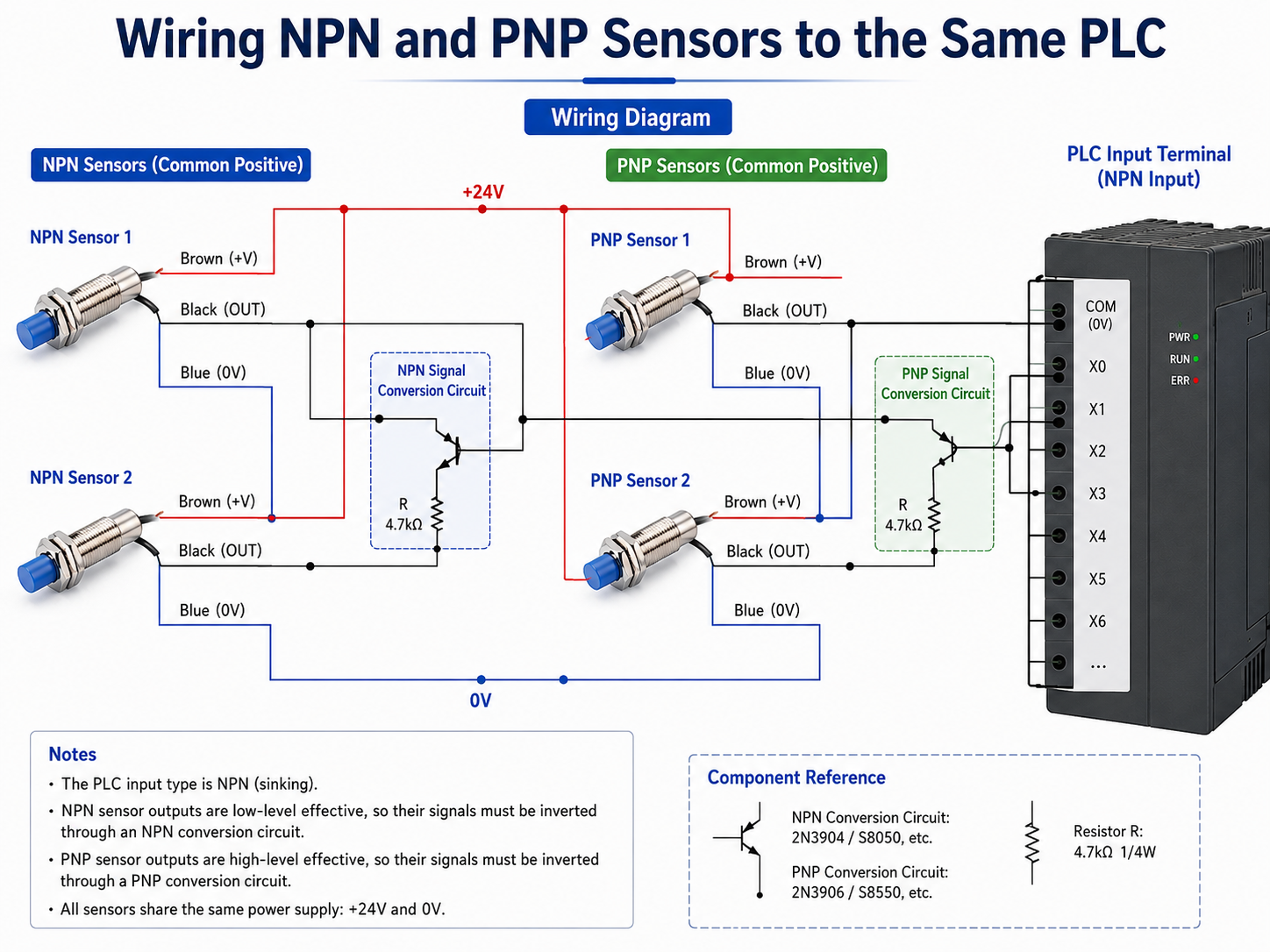
In an automated environment, it is sometimes the case that the same device has both NPN output sensors and PNP output sensors. Can these be directly connected to the input module of the same PLC? The answer is: No, they cannot be mixed directly. Otherwise, there will be electrical risks.
Ⅰ. Why can't they be directly connected?
The internal circuit structures of NPN and PNP outputs are different:
NPN output: The output terminal is at a low voltage level (0V). The load end is connected to the positive power supply. When the sensor conducts, the output terminal is connected to 0V.
PNP output: The output terminal is at a high voltage level (the positive terminal of the power supply), the load end is connected to 0V, and when the sensor conducts, the output terminal is connected to the positive power supply.
If two types of output sensors are simultaneously connected to the same common port (COM) of the PLC input terminal, and this common port can only be connected uniformly to positive or uniformly to 0V, it will result in:
Current interlock: When both the NPN and PNP outputs are activated simultaneously, a short circuit path may be formed between the positive power supply and 0V through the internal circuitry of the PLC. This could result in minor signal errors or, in severe cases, damage to the PLC input terminals or the sensor output stage.
Logical conflict: The common input terminal of the PLC can only define one valid level (either high level or low level is considered valid), and it cannot simultaneously support two polarities.
II. Correct Handling Methods
There are two mature and reliable solutions:
Solution 1: Connect different public terminals of the input modules separately
Select PLC input modules with multiple independent public terminals (such as a group of COM for every 8 points). Connect NPN sensors to one group of public terminals and connect PNP sensors to another group of public terminals, with the former connected to the input port with 0V (low level valid) and the latter connected to the positive power supply input port (high level valid). The two groups are isolated from each other and do not interfere with each other.
Option 2: Uniformly convert all to a single output type
During the selection or renovation process, try to make all the sensors have the same output type (all NPN or all PNP). This way, they can be directly connected to the input module of the same common terminal, which is the simplest and most reliable method.
Option 3: Use intermediate relay for isolation
First, drive the output of the NPN or PNP sensor through the coil of an intermediate relay, and then connect the relay's contacts (passive dry contacts) to the PLC input. The relay contacts do not have polarity and can be mixed arbitrarily. This method is suitable for scenarios where the sensor cannot be replaced and the common terminal of the PLC input module cannot be separated. However, it will increase wiring and cost.
III. Summary of Risks of Incorrect Wiring
Incorrect Practice Consequences
Connecting NPN and PNP output lines in parallel or to the same common terminal directly Current interconnection, signal errors, and possible module damage
IV. Selection Suggestions
During the project planning stage, it is recommended to uniformly adopt the same type of output sensor throughout the system to simplify wiring and enhance reliability. If there is already a mixed situation on-site, prioritize the use of zone-based connection or relay isolation solutions.
Rihuan Sensor offers a full range of NPN and PNP sensor products. The models are clear and the selection is convenient. It supports a unified output type for the entire system, reducing the troubles of mixed connections. Welcome to follow Rihuan Sensor to obtain more reliable sensor solutions.
