Today, Wuxi Rihuan Sensor Technology Co., Ltd. will introduce the four-step method for selecting security door locks: identify risks and ensure equipment safety.
In the safety protection of industrial equipment, safety door locks are the key components that ensure the reliable stoppage of the equipment before personnel enter the dangerous area. Incorrect selection can lead to either incorrect shutdown or even safety accidents. The following four core principles can help enterprises quickly and accurately select the appropriate safety door locks.
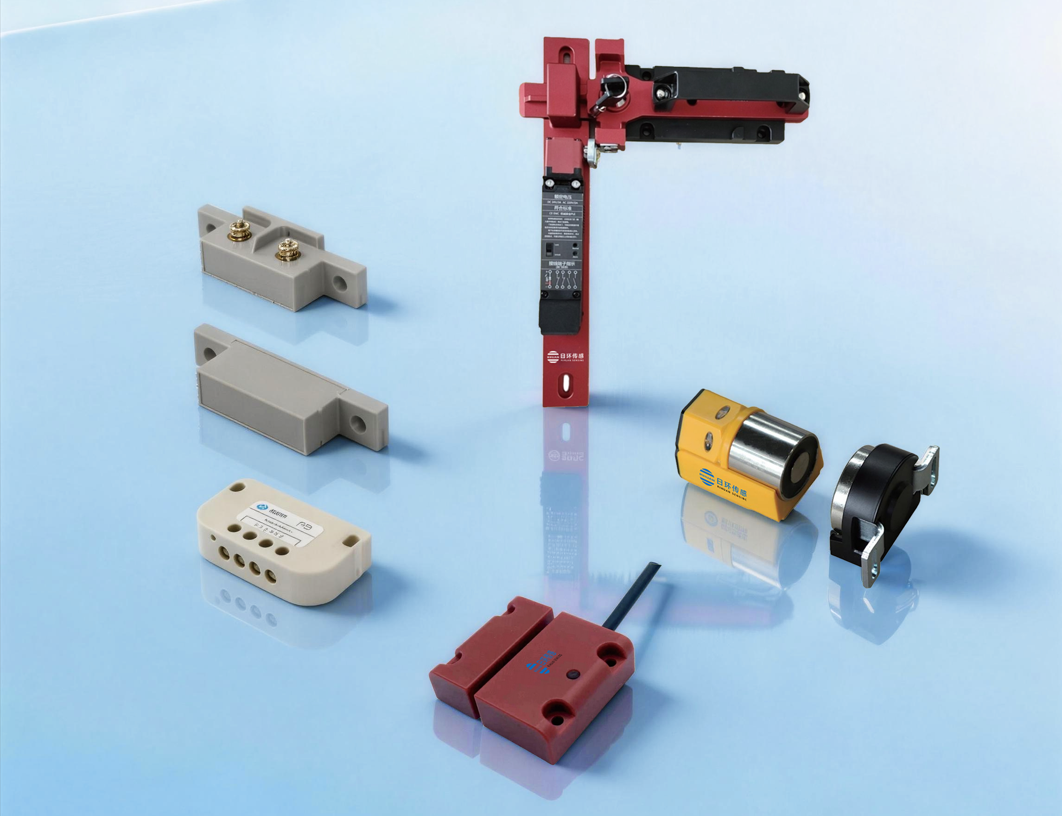
First: Is electromagnetic locking required?
If there is inertial movement (such as fans, flywheels, rotating shafts, etc.) after the equipment stops, or if the production cycle requires that the equipment cannot stop immediately (for example, the assembly line cannot stop instantly), an electromagnetic locking type safety door lock must be selected.
The electromagnetic locking door lock secures the protective door when the equipment is powered on or in operation. The door lock can only be released when the equipment has completely stopped and the inertial movement has ended. On the contrary, if a regular mechanical door lock is used, the door will open as soon as it is pulled, and operators may enter the dangerous area before the equipment is completely stationary, which is very likely to cause serious injuries.
Second: Select the interlock type based on the risk level
Based on the results of the equipment risk assessment, choose the interlock method for the safety door lock:
Low-risk: Mechanical interlock can be adopted. That is, the power circuit is directly cut off through the mechanical structure of the door lock. The structure is simple and the cost is low.
Medium to high risk: Electromagnetic interlock combined with dual redundant contacts should be selected. The dual redundant contacts ensure that the safety signal remains reliable even if one of the contacts fails; the electromagnetic lock further prevents accidental door opening.
High risk: In addition to electromagnetic interlock and redundant contacts, an additional encoding anti-tampering function must be added. Each lock head of the encoded safety door lock has a unique electronic code that cannot be triggered by ordinary tools or foreign objects, preventing human short-circuiting or shielding.
Third: Select the installation form based on the working conditions
Dust and humid environments: It is recommended to use non-contact safety door locks, such as RFID encoded locks or magnetic encoded locks. There is no mechanical wear, no risk of dust accumulation or jamming, and the protection level can reach above IP67.
Strong vibration and impact conditions: A mechanical hard-coupled door lock should be selected, along with a deeper guide insert. The deeper the insert is inserted, the more reliable the locking will be, and it can effectively resist signal interruption caused by vibration.
Fourth: It is necessary to confirm the safety contacts and the certification qualifications.
No matter which type of security door lock is chosen, the following two points are the strict requirements:
The contacts must be of the forced-off type: even in the case of contact sticking, the forced-off mechanism can physically separate the contacts when the door is opened, ensuring that the safety signal is reliably cut off.
It must have authoritative safety certification: At least it should have TÜV and CE certifications, and clearly indicate the SIL level (such as SIL2, SIL3) or performance level (PL). Door locks without these certifications cannot be used in safety circuits.
When selecting the type of security door lock, one should not merely consider the price or appearance. Instead, it should be judged comprehensively from four aspects: "whether electromagnetic locking is required", "risk level", "working conditions", and "contacts and certification". Only by correctly selecting a security door lock can the condition of "the equipment stops when the door is closed, and starts when the door is opened" be achieved.
Rihuan Sensing offers a full range of mechanical, electromagnetic and encoder types of security door locks. All products feature mandatory disconnection contacts and have passed TÜV, CE and SIL level certifications, meeting the needs of different risk levels and harsh working conditions. Choosing Dayring Sensing means no worries about safety selection. Welcome to consult for technical and selection support.
