Today, Wuxi Rihuan Sensing Technology Co., Ltd. will introduce to you diffuse reflection, mirror reflection and beam-reflective photoelectricity: Choose the wrong one and you'll waste your money in vain.
Photoelectric sensors are one of the most common detection components in industrial automation. Depending on the structure of the light path, they are mainly divided into diffuse reflection type, mirror reflection type and beam-shooting type. The three types have different principles and significant performance differences. Once the selection is incorrect, it may result in unstable detection in the case of minor issues, or complete non-functionality in the case of serious errors. The following will explain each one in detail.
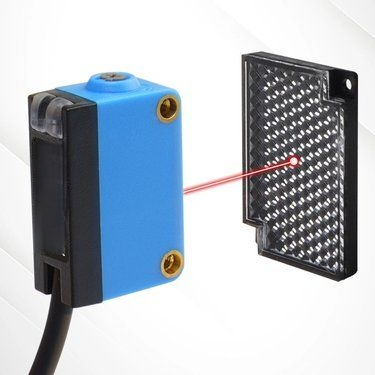
I. Retro-reflective Photoelectric
Principle: The emitter and receiver are installed separately, and the light is directly aimed at each other. When the measured object blocks the light path, the signal of the receiver changes.
Detection range: The farthest distance can reach tens or even hundreds of meters.
Advantages: The detection range is long, unaffected by the color or reflectivity of the object surface, and the reliability is high.
Disadvantages: It is necessary to install transmitters and receivers at both ends respectively, which results in a large amount of wiring work and occupies a large space. Moreover, high installation accuracy is required.
Typical applications: Long-distance object detection, storage and logistics channels, safety protection of large equipment, etc.
Common faults: The optical axes of the transmitter and receiver are misaligned (caused by mechanical vibration); The lens is covered with dust or oil.
II. Mirror Reflective Photoelectric
Principle: The transmitter and receiver are integrated within the same housing. Light is reflected back by the reflective plate (mirror). When the measured object blocks the light, the receiver fails to receive the reflected light.
Detection range: Medium. Usually it is between several meters and several tens of meters (depending on the size of the reflector).
Advantages: It can be installed on only one side, and the wiring is simpler than that of the beam-type; the detection distance is significantly greater than that of the diffuse reflection type.
Disadvantages: A dedicated reflector plate must be configured (ordinary mirrors cannot be used as a substitute; otherwise, false detections may occur due to the polarization light characteristics); dirt or wear on the reflector plate will significantly affect reliability.
Typical applications: Automatic doors, packaging lines, warehouse rack position detection, suitable for situations requiring moderate distance and with limited installation space.
Common faults: The reflective panel becomes dirty, gets scratched or falls off, resulting in signal attenuation and causing incorrect triggering or no triggering. Additionally, strong reflective background objects (such as highly reflective metals) may cause "false reflection", causing the sensor to wrongly judge as light transmission when the measured object is not blocked.
III. Diffuse Reflective Photoelectric
Principle: The emitter and receiver are integrated together. When light shines on the surface of the measured object, some of the light is diffusely reflected back to the receiver. The presence or absence is determined by the intensity of the reflected light.
Detection distance: Recently, it is usually between several tens of millimeters and about one meter (greatly affected by the color and material of the object).
Advantages: The installation is the most convenient. Only one component is needed, and there is no need for a reflector or installation on the opposite side. It is suitable for short distances and compact spaces.
Disadvantages: The detection distance is strongly correlated with the reflectivity of the object's surface - the distance for black objects is significantly shortened, and mirror-like objects may exhibit abnormal reflections. It is susceptible to interference from background objects.
Typical applications: detecting the presence or absence of parts, confirming the arrival of products, and determining the positions of opaque objects on automated assembly lines.
Common Fault: Background Interference - When there is a nearby wall, conveyor belt or other object behind the object being measured, the sensor may mistakenly detect the background and fail to accurately identify small objects; in addition, changes in the color of the workpiece surface can cause the detection distance to be unstable.
Selection Summary
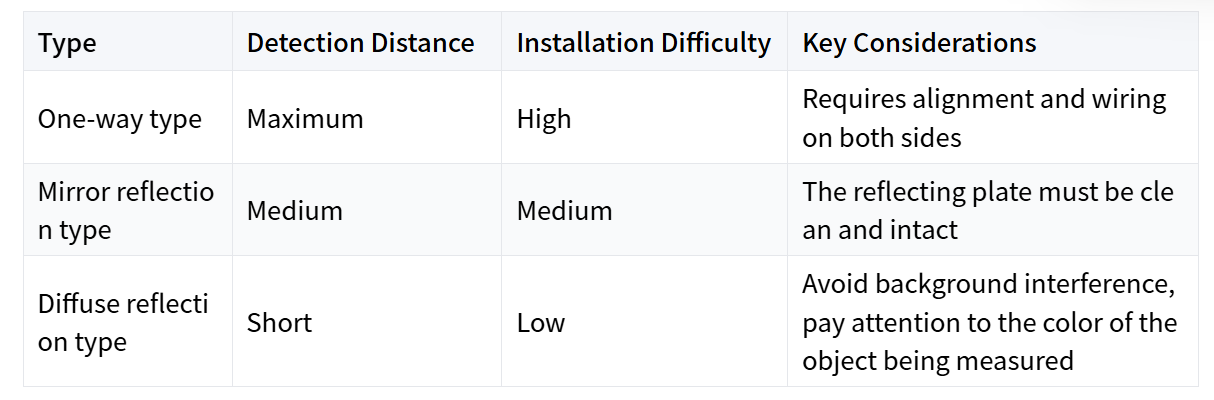
One piece of advice: For long-distance scenarios where both sides of the wiring can be used, the beam-type is the preferred choice; if you want to save half of the wiring and have a moderate distance, the mirror-reflection type should be selected while ensuring the protection of the reflecting plate; if the distance is very short, you only want to install a single head and there is no background interference, the diffuse reflection type is the most convenient option.
Quick Troubleshooting for Common Faults on Site
Mirror reflection not working: First, check if the reflecting plate is dirty or detached; then, check if there is any obstruction in the light path.
Diffuse reflection misoperation: Check if there are reflective or light-colored objects in the background; try to shorten the detection distance or adjust the installation angle.
Crossfire instability: Check if the transmission and reception are aligned; Clean the lens; Check if it is directly exposed to strong light.
Proper selection and installation of the sensor are essential to ensure it operates at its optimal performance, avoiding repeated adjustments and unnecessary energy losses.
Rihuan Sensing offers a full range of photoelectric sensors - including beam type, mirror reflection type, and diffuse reflection type models. The detection range covers from centimeters to tens of meters, and it is equipped with enhanced functions such as anti-interference and background suppression. If you need guidance on selection or technical support, please follow Dayuan Sensing.
