Today, Wuxi Rihuan Sensing Technology Co., Ltd. will introduce the key selection and usage points for the application of optical fiber sensors.
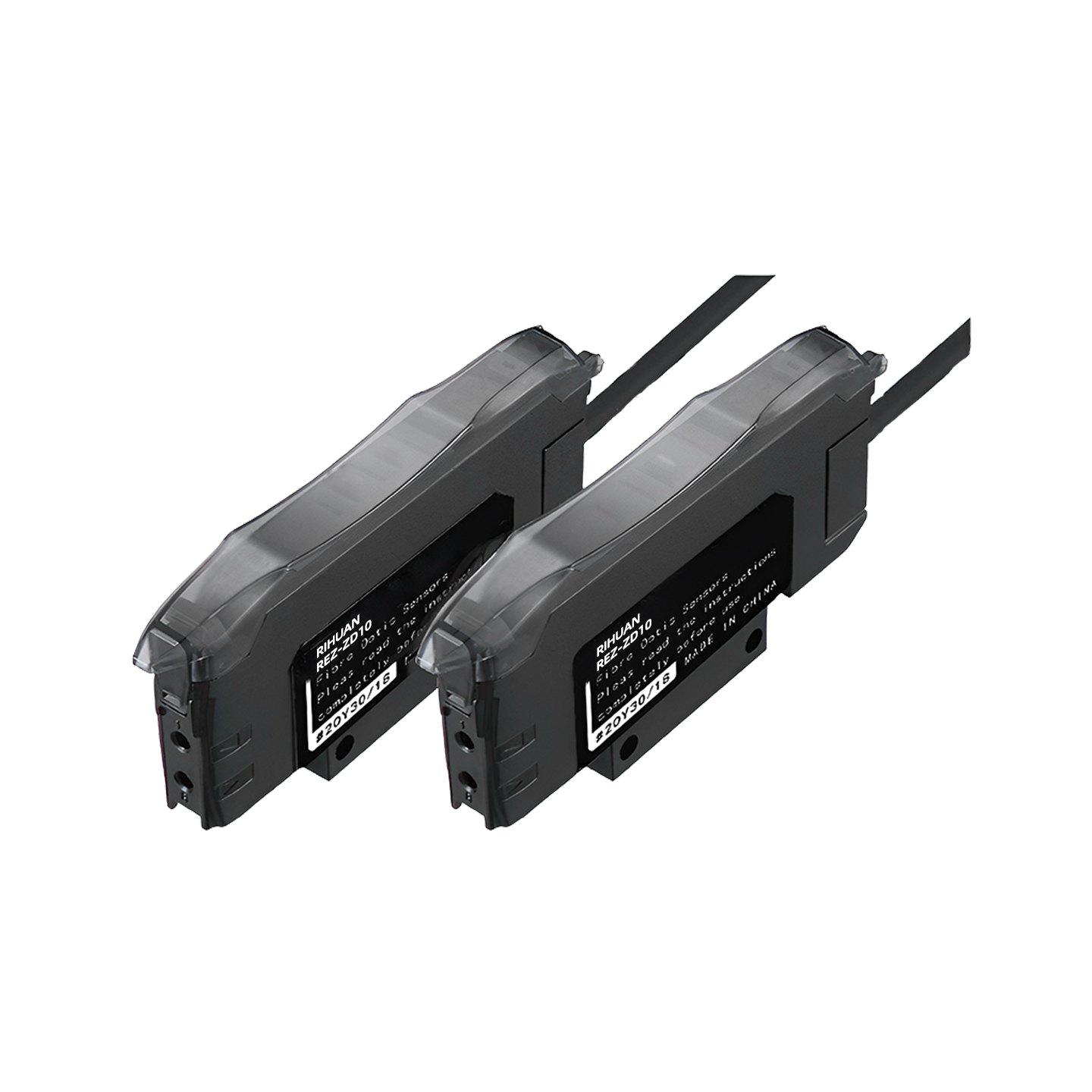
I. Selection Requirements for Optical Fibers
Optical fibers are the core transmission components of optical fiber sensors. The mainstream types include step-index / graded-index multimode fibers and single-mode fibers. When selecting, the following four core indicators need to be controlled based on the actual application requirements:
Numerical Aperture (NA): Preferentially choose fibers with a large numerical aperture. The conventional range is 0.2 ≤ NA < 0.4. This can enhance the coupling efficiency between the light source and the fiber. Since optical fiber sensors do not have requirements related to information capacity, the influence of large numerical aperture on mode dispersion does not need to be considered.
Transmission loss: No strict screening is required. Using optical fibers with a loss of less than 10 dB/km is sufficient for the application. This is because the transmission distance of the sensor is extremely short. In most scenarios, the maximum distance does not exceed 4 meters, and the minimum distance is only a few millimeters.
Dispersion index: This parameter only affects the information capacity and does not match the application scenarios of optical fiber sensors. Therefore, when selecting, the requirements can be significantly relaxed.
Mechanical strength: As a mandatory requirement, all optical fibers in all application scenarios must have high strength to withstand bending and pulling during installation and usage, and to prevent component damage.
II. Selection and Adaptation Principles of Light Sources
The light source provides optical signals to the sensor. Different types of light sources have significant differences in their characteristics, and selection should be based on the specific scenario, while following a unified adaptation principle:
Applicable characteristics of various light sources
Incandescent light source: Low cost, easy to obtain, convenient to operate, but with low radiation density, can only be used with fiber bundles and thick-core step-index fibers, and the equipment has poor stability and a short lifespan;
Gas laser: A high-coherence light source that can easily achieve single-mode operation, with narrow spectral linewidth and high radiation density, excellent coupling efficiency with single-mode fibers, low equipment operation noise, suitable for high-precision detection scenarios;
Solid-state laser: Represented by solid-state rubidium ion lasers, small in size, sturdy in structure, with high efficiency and high radiation density advantages, uniform spectrum and narrow lines, slightly inferior to gas lasers in coherence and frequency stability;
Semiconductor laser (with LED as the core): The mainstream adapted light source for fiber sensors, small in size, highly resistant to damage, long lifespan, high reliability, moderate radiation density, and simple power supply system, suitable for most conventional application scenarios.
General selection principles
The radiation power of the light source should be sufficient, achieving maximum radiation power within the working wavelength range of the sensor's sensitive element;
The light source and the fiber optic model must be precisely matched to ensure that the coupling efficiency between them is at its optimal level and to minimize signal transmission loss.
The stability of the light source must meet the requirements. It should be capable of operating continuously at room temperature to ensure that the detection system maintains an adequate signal-to-noise ratio.
III. Selection Criteria for Photodetectors
The photodetector is a key component for converting light signals into electrical signals, directly affecting the accuracy of the detection results. The selection must strictly follow six core standards:
High sensitivity: Within the working wavelength range of the sensor, it should have excellent signal capture capability and be able to accurately identify weak light signals;
Low noise interference: The noise introduced by the device itself should be minimized. Preferentially select products with extremely small values for dark current, leakage current, and parallel conductance.
High stability and reliability: Capable of adapting to various working environments, it can operate continuously for a long time, reducing equipment failures and detection errors;
Easy installation coupling: The size should be compact to facilitate the assembly of the entire equipment, and it should also be capable of quickly and conveniently coupling with optical fibers, thereby reducing the construction difficulty.
Low power consumption and easy power supply: The required bias voltage and bias current should not be too high, which simplifies the design of the power supply system and controls the energy consumption of the equipment at the same time.
High cost-effectiveness: While meeting all performance requirements, it also takes into account economic factors, and reasonably controls the costs of procurement and application.
Rihuan Sensing has been deeply engaged in the field of optical fiber sensing. It has integrated the above selection criteria into product research and design. By combining high compatibility optical fibers, stable light sources, and low-noise detectors, it has launched optical fiber sensing products suitable for industrial monitoring and other scenarios. With high cost-effectiveness and reliability, it provides precise and efficient perception support for various complex working conditions.
