Hall sensors, as an important component in modern technology, play a key role in multiple industries due to their unique working principle and wide range of applications. The following will systematically elaborate from the principle to specific applications:
I. Working principle Based on the Hall effect
The core technical basis of the Hall sensor is the Hall effect discovered by the American physicist Edwin Hall at the end of the 19th century. When current passes through a conductor, a potential difference (i.e., Hall voltage) is generated in a direction perpendicular to both the current and the magnetic field, and this voltage value is directly proportional to the magnetic field strength. Based on this physical phenomenon, Hall sensors can precisely convert magnetic field changes into electrical signal outputs.
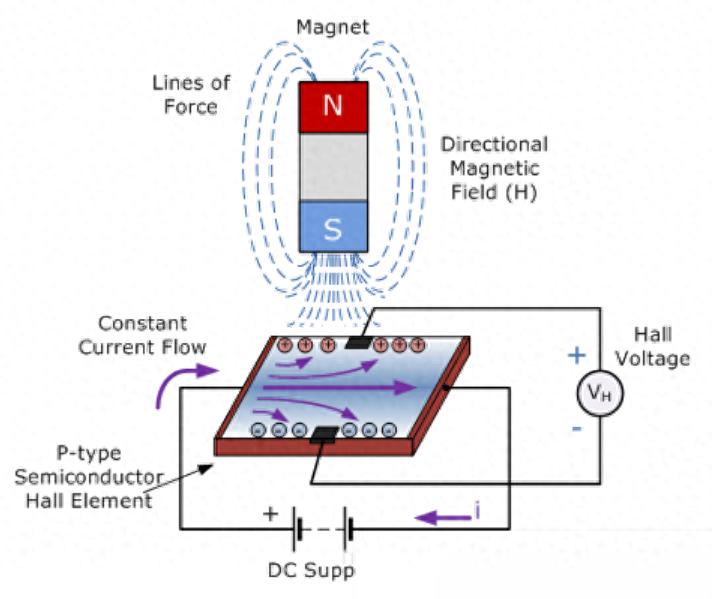
Ii. Core Applications in the Field of Industrial Control and Automation
Speed measurement and position detection: By being installed on the rotor of a motor or rotating machinery, it can detect the rotational status of magnetic components in real time, providing precise data support for the automation system
Anti-lock Braking System (ABS) : By monitoring the changes in wheel speed, it effectively prevents wheel lockup during emergency braking, significantly enhancing driving safety performance
Iii. Key Roles in the Automotive Industry
Ignition and fuel injection system: By detecting the positions of the crankshaft and camshaft, it precisely controls the ignition timing and fuel injection sequence, optimizing engine performance and fuel economy
Vehicle speed monitoring system: Sensors installed on the wheels provide real-time vehicle speed data to the dashboard and on-board computer
Iv. Innovative Applications in the Consumer Electronics Field
Human-computer interaction devices: In devices such as keyboards and touch screens, switch control and touch functions are achieved by detecting the movement of magnets
Current measurement device: Precisely monitors current changes
Medical imaging equipment: In magnetic resonance imaging (MRI) systems, by detecting the gradient changes of strong magnetic fields, high-definition three-dimensional diagnostic images are generated
V. Precision Support for Medical Equipment
Blood glucose detector: It achieves rapid detection by measuring the magnetic field changes caused by blood glucose variations on the test strip
Hearing aid devices: Precisely adjust volume parameters to improve the effect of hearing assistance
Vi. Technological Development and Future Outlook
With the advancement of technology, the measurement accuracy and stability of Hall sensors have been continuously improving, and their application boundaries are expanding into emerging fields such as the Internet of Things and smart homes. This technology provides an important data interface for digital control systems by converting the magnetic field changes in the physical world into quantifiable electrical signals.
Hall sensors, with their reliable technical features and continuously innovative application models, are becoming an important technical support for promoting the intelligent upgrade of various industries. In the future, they will demonstrate greater value in cutting-edge fields such as Industry 4.0 and smart healthcare.
