Today, Wuxi Rihuan Sensing Technology Co., Ltd. will introduce to you a guide for purchasing laser displacement sensors: Five core dimensions precisely match your needs.
In numerous fields such as intelligent manufacturing, precision inspection, and automated production lines, laser displacement sensors have become indispensable measuring devices due to their advantages of high precision, high response speed, and convenient operation. However, the numerous brands and diverse models of products on the market often put users in a dilemma when making a purchase. In fact, as long as you closely adhere to your actual needs and screen layer by layer from key dimensions, you can find the most suitable product. The following will provide a detailed analysis of the selection logic of laser displacement sensors from five core aspects.
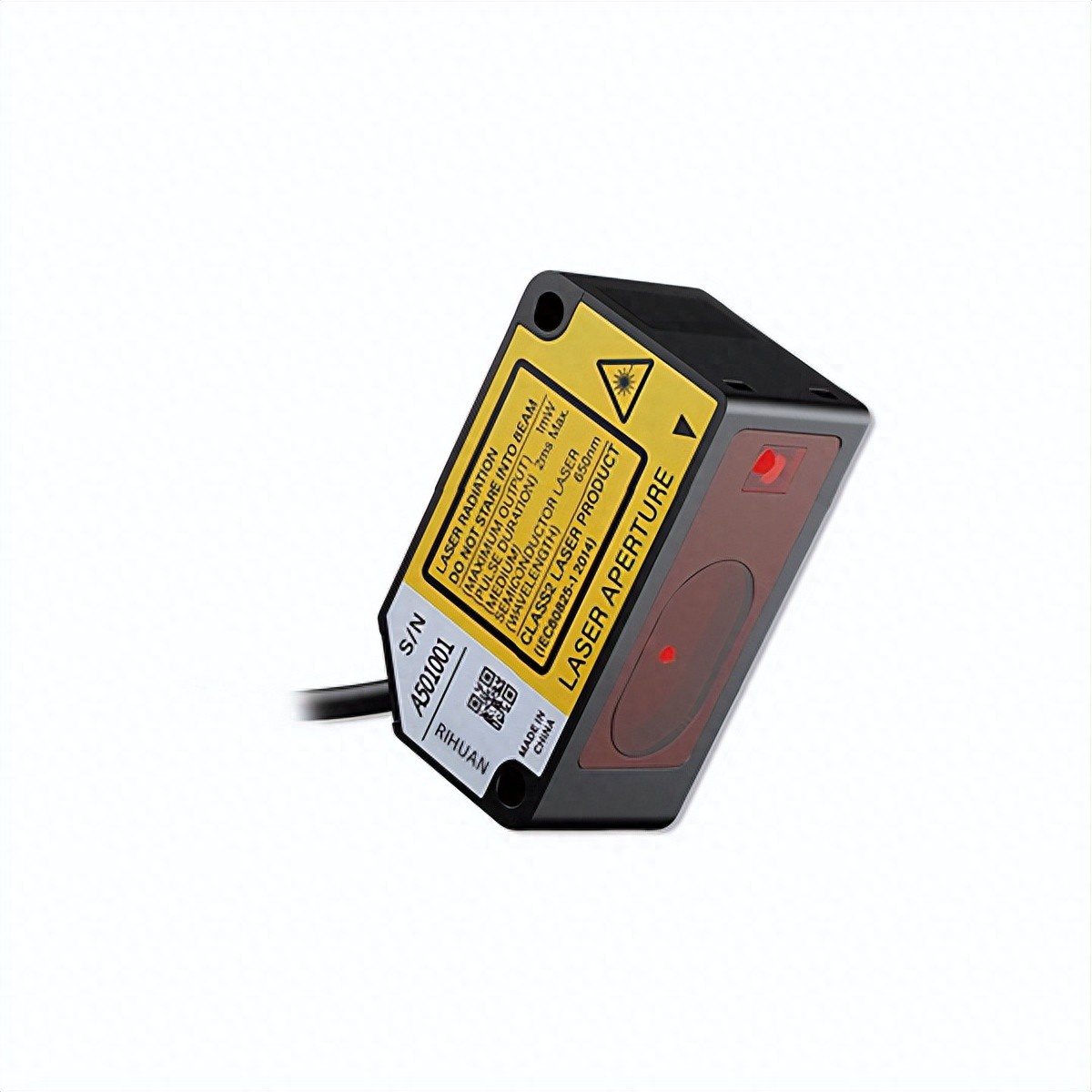
I. Anchoring the measurement object: Lock the basic compatibility from the perspective of structure and material
The measurement principle of laser displacement sensors relies on the closed-loop optical path of laser emission, reflection and reception (the mainstream methods are triangulation or pulse time method), and the structure and material of the measured object directly determine whether the optical path can be stably formed, which is the primary prerequisite for purchase.
In terms of structure, particular attention should be paid to the surface flatness and shape of the measurement target. For conventional workpieces with smooth surfaces and no obvious concavities or convexities, ordinary laser displacement sensors can meet the requirements. However, for complex structural components with deep depressions or grooves on the measurement surface (such as gear tooth grooves and precision mold cavities), a micro laser displacement sensor with a smaller laser spot and stronger optical path adaptability should be selected to avoid optical path interruption caused by uneven spot coverage.
Material properties are equally crucial. For materials with good reflectivity such as metal and glass, conventional diffuse reflection laser displacement sensors can work efficiently. However, for highly light-absorbing materials such as black plastic, carbon fiber, and light-absorbing coatings, or highly reflective materials such as mirror-finished stainless steel and polished ceramics, it is necessary to select dedicated models specifically - light-absorbing materials are compatible with sensors that enhance laser power, while highly reflective materials need to be paired with sensors that have anti-reflection algorithms to ensure stable reception of reflected light signals.
Second, focus on core parameters: Match scene requirements with precision and efficiency
Parameter indicators are the core manifestation of the performance of laser displacement sensors. The requirements for parameters vary greatly among different industry scenarios, and precise matching is necessary to avoid "excess performance" or "insufficient accuracy".
Precision parameters are of Paramount importance, mainly including resolution, linearity and repeatability accuracy. In scenarios such as electronic component packaging (for example, measuring the height of chip pins) and processing of micro-precision parts, extremely high precision is required. High-precision sensors with a resolution of 0.01μm and a linearity better than ±0.1%FS need to be selected. In scenarios such as height inspection of goods and rough measurement of sheet thickness in warehousing and logistics, the precision requirements are relatively loose. Products with a resolution of 0.1μm and a linearity of ±0.5%FS can meet the demands.
The measurement rate and range also need to be selected as required. In high-speed automated production lines (such as high-speed inspection of lithium battery electrode sheets and online screening of bottle cap sizes), to ensure that no inspection point is missed, high-speed sensors with a measurement rate of ≥10kHz should be selected. In the long-distance measurement of static workpieces (such as the installation and positioning of large equipment), the rate requirement can be reduced to below 1kHz, but it is necessary to ensure that the measurement range meets the measurement distance requirements (such as large-range sensors with a range of 0-5 meters). In addition, attention should also be paid to the matching between the sampling frequency and the data output interface to ensure that the sensor data can be efficiently transmitted to the control system.
Iii. Adapt to Application Environment: Resist interference to ensure stable operation
The working environment of laser displacement sensors often contains various interfering factors. If the environmental adaptability is insufficient, it will seriously affect the measurement stability. Therefore, environmental adaptability is a dimension that is often overlooked but is crucial when making a purchase.
First, pay attention to the temperature and humidity of the environment. In high-temperature workshops (such as metallurgical and casting production lines), high-temperature resistant models (typically with a working temperature range of -20℃ to 80℃ and above) should be selected, and it should be confirmed whether the sensor has a heat dissipation structure. In damp food processing workshops and outdoor open-air operation scenarios, products with a protection level of IP67 or above should be selected to prevent water vapor and dust from entering the internal circuits.
In addition, targeted protection is required in special environments. In scenarios such as welding and cutting where there is strong light and electromagnetic interference, sensors with anti-electromagnetic interference (EMC) certification and strong light shielding function should be selected. In scenarios with vibration and shock (such as machine tool processing and construction machinery inspection), sensors with an anti-vibration grade of ≥10g should be selected to ensure stable measurement data in bumpy environments. For flammable and explosive environments (such as the chemical and oil and gas industries), it is necessary to select explosion-proof laser displacement sensors with explosion-proof grades that meet the on-site requirements.
Iv. Consider functional requirements: Scalability and intelligence enhance application value
With the improvement of automation and intelligence levels, the additional functions of laser displacement sensors have gradually become the key to enhancing production efficiency. It is necessary to select products with corresponding expansion capabilities based on the functional requirements of the scene.
In terms of data processing and analysis functions, if real-time statistics of measurement data and abnormal alarms (such as early warnings for part size deviations) are required, sensors with built-in data processing modules and support for threshold Settings should be selected. If the data needs to be connected to the factory MES system for subsequent analysis, it is necessary to ensure that the sensors have mainstream industrial communication interfaces such as Ethernet, PROFINET, and Modbus.
The convenience of installation and commissioning also needs to be taken into consideration. For installation in confined Spaces (such as precise detection inside equipment), it is necessary to choose sensors that are compact in size and support multi-angle installation. If the measurement stations need to be frequently changed on site, sensors with wireless communication functions and support for remote debugging can be selected to reduce on-site wiring and debugging costs. In addition, in some scenarios, the sensor also needs to have special functions such as multi-target measurement, distance compensation, and temperature calibration. These need to be verified one by one when purchasing.
